The 2026 ATS Product Wars: What Recruiters Actually Want
Greenhouse, Teamtailor, and SmartRecruiters all shipped the same class of feature in 2026. Here is what the ATS market is really converging on, and how to buy.

Ernest Bursa
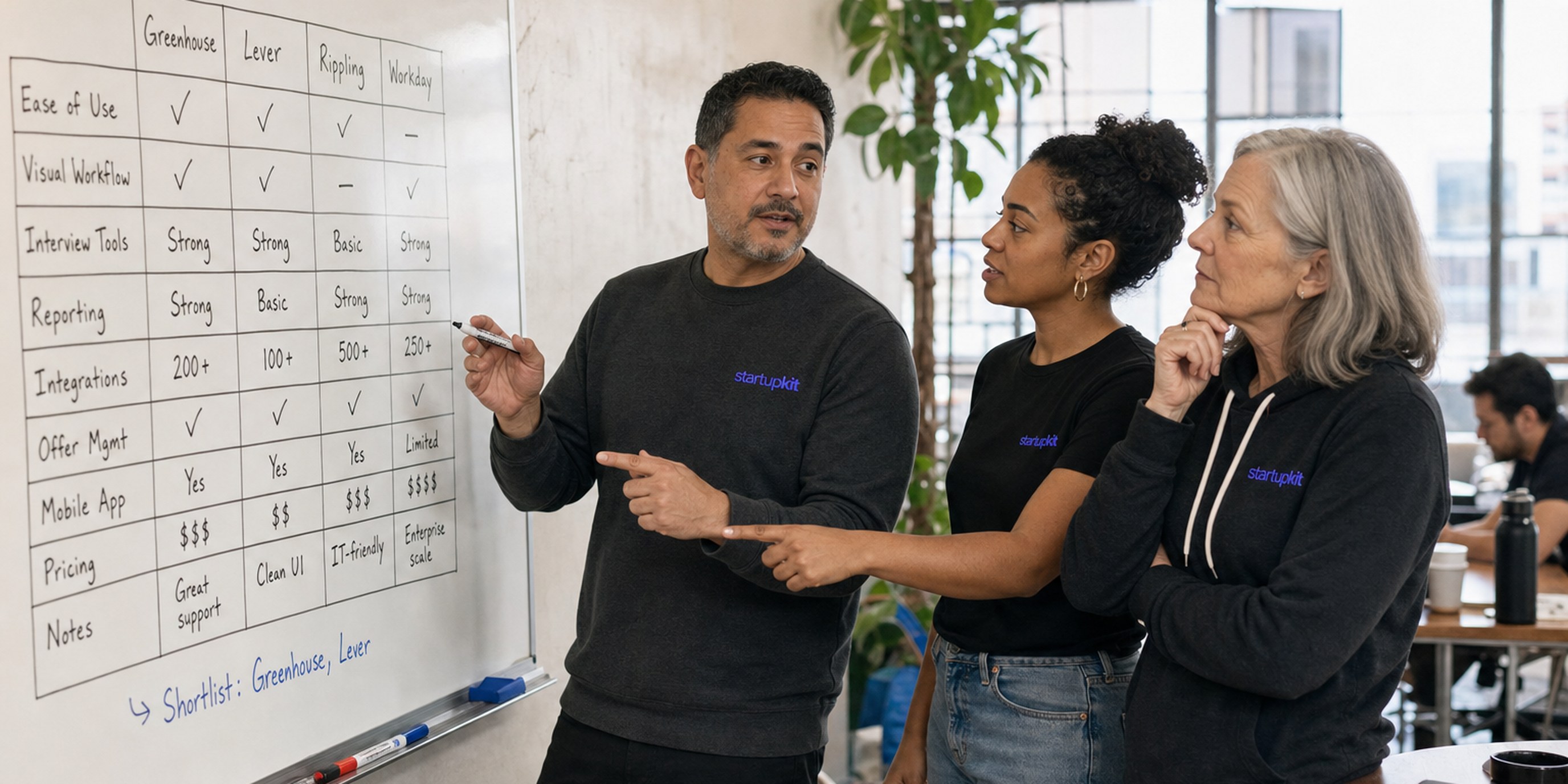
In 2026, the major ATS vendors converged on two things: consolidating candidates into one cross-job view, and owning candidate communication through native channels. They did not simply add more AI screening. If you are shopping for an applicant tracking system this year and every demo sounds like the same AI pitch, that convergence is the signal underneath the noise. This is what Greenhouse, Teamtailor, and SmartRecruiters actually bet on, and what it means for how you should buy.
What Greenhouse, Teamtailor, and SmartRecruiters just shipped
The three biggest names in modern recruiting software all released significant updates in mid-2026. Read them side by side and a pattern appears that no single vendor is advertising: the race is to unify the workspace and own the conversation, with AI treated as plumbing rather than the headline.
Here is what each one actually shipped, straight from their release notes.
| Vendor | Headline recent release | Consolidation move | Direct candidate channel | AI posture |
|---|---|---|---|---|
| Greenhouse | Greenhouse Analytics (open beta, June 2026): calculated fields, global dashboard filters, AI chart builder | Unified analytics and dashboards across the pipeline | Structured but email-centric | AI Report Insights slated for August 2026; AI as an interface layer |
| Teamtailor | Cross-job Applications view plus native WhatsApp messaging | One board or list across all active jobs | Native WhatsApp, email, and SMS in one unified inbox | AI features present, not the release headline |
| SmartRecruiters | July 2026: access-scoped @mention controls plus SmartAssistant | Controlled collaboration surface for notes and feeds | Messaging present, governance-focused | SmartAssistant scores and ranks candidates against job requirements |
Greenhouse: analytics as an interface, not a verdict
Greenhouse Analytics entered open beta in June 2026, with calculated fields, global dashboard filters, and expanded data coverage across approvals and scorecards. The most telling piece is the AI chart builder: you describe the chart you want and it assembles it. AI Report Insights is slated for August 2026.
Notice what this is not. It is not an AI that decides who to hire. It is AI as an interface layer sitting on top of your own data, helping you ask questions faster. The verdict stays with you.
Teamtailor: one board across every job, plus WhatsApp
Teamtailor shipped a cross-job Applications view that pulls applicants from every active job into one place. You get board and list layouts, drag-and-drop across stages without opening individual jobs, filters, search, and pinned jobs. A recruiter juggling eight open roles no longer bounces between eight separate pipelines to see where attention is needed.
Alongside it came native WhatsApp messaging that lands in the same unified inbox as email and SMS, supporting one-off, bulk, and trigger-automated sends. In markets where candidates live on WhatsApp, that channel now sits inside the candidate record instead of on a recruiter’s personal phone.
SmartRecruiters: collaboration with guardrails
SmartRecruiters’ July 2026 release added access-scoped @mention controls. When you tag a colleague, the suggestions are filtered to the roles and jobs that person can actually access, so you cannot accidentally pull someone into a requisition they should not see. Its SmartAssistant engine scores and ranks candidates against job requirements.
The interesting move here is not the AI scoring, which every vendor now has. It is that collaboration and AI both come wrapped in governance. Data control is the feature.
The real convergence is not AI screening
Every vendor claims AI. That is exactly why AI is no longer the differentiator. The 2026 releases converge on two moves that have nothing to do with screening resumes faster.
Move one: consolidation. One cross-job view instead of per-job silos. Teamtailor’s Applications view is the clearest example, but Greenhouse’s unified analytics and SmartRecruiters’ single collaboration surface are the same instinct. The old model gave every job its own pipeline, its own inbox, its own context. The new model gives the recruiter one surface and lets them filter down.
Move two: direct candidate channels owned inside the ATS. Teamtailor’s native WhatsApp in a unified inbox is the literal version. The principle is broader: the conversation with a candidate should live on the candidate’s record, not scattered across a recruiter’s personal email, a spreadsheet, and a disconnected SMS app.
Why now? Because both moves solve the same underlying problem: context loss. When a candidate lives in one job’s silo, the recruiter working three other roles never sees them. When a message goes out from a personal inbox, the next person to touch that candidate has no idea it happened. Consolidation and native channels are both bets that the scarce resource in hiring is not screening throughput. It is shared context across a team and across roles.
AI scoring did not disappear. It became table stakes, and then it got governed. SmartRecruiters’ access-scoped mentions and Greenhouse’s describe-your-chart builder both point the same way: AI is being folded into the workflow as an assistant you can audit, not paraded as a black-box decision-maker. That shift matters, because AI resume screening has a documented track record of encoding disparities when it runs unchecked. Governance is not a nice-to-have; it is what makes AI defensible.
If you want the deeper version of this argument, we wrote about what “AI-native” actually means for an ATS and why the label is mostly abused.
Why legacy per-seat ATS tools leave this gap open
Here is the structural irony. The convergence every incumbent is chasing (one inbox, native candidate channels, whole-team collaboration) is precisely what traditional per-seat pricing fights against.
When an ATS charges a meaningful amount per user and gates collaboration features behind higher tiers, the rational move for a budget-conscious team is to limit seats. You give recruiters full access and leave hiring managers, interviewers, and coordinators on the outside. So they work around the tool. They forward candidate emails to their personal inbox. They keep a side spreadsheet. They text a candidate from their own phone to move faster.
Every one of those workarounds fragments the exact thing the 2026 releases are trying to consolidate. You cannot have one unified candidate record if half the people touching the candidate are not in the system. The unified inbox is worthless if the interviewer’s feedback lives in a Slack DM nobody logged.
This is why the pricing model is a product decision, not just a line item. A tool that makes it expensive to involve the whole hiring team structurally guarantees the fragmentation the newest features are meant to solve. It is worth reading the fine print on how a vendor charges for collaborators before you believe the “unified” pitch.
The tell is easy to spot in a demo. Ask the salesperson to add three interviewers and a hiring manager to a requisition, live, and watch what happens to the quote. If the number jumps or a feature you just saw gets greyed out on the lower tier, you have found the seam where your team will end up working around the product.
How big is the ATS market, really?
The category is growing, but slower than the hype implies, and the biggest numbers you will see quoted usually belong to a broader category than “ATS.”
The applicant tracking system market specifically sat around $3.0 to $3.3 billion in 2025 and 2026. MarketsandMarkets projects it reaching $4.88 billion by 2030; Grand View Research puts it closer to $3.71 billion by 2030. CAGR estimates cluster in the 6 to 8 percent range. Steady, not explosive.
The huge growth figures live one level up, in the broader “AI in recruitment” category. Pin estimates that market at roughly $8.2 billion in 2025 growing to about $15.2 billion by 2030, a ~24.8% CAGR. The $8.2B and $15.2B endpoints over five years imply roughly 13.1% CAGR, so 24.8% should not be treated as the growth rate of that same forecast. The AI resume-screening sub-segment specifically grows at about 17.1% CAGR per Mordor Intelligence. Those are real numbers, but they describe AI-in-hiring writ large, not the ATS you actually buy.
The practical takeaway: if a vendor waves a double-digit growth chart at you, check whether it describes ATS software or the entire AI-in-recruitment universe. The gap between those two figures is roughly the gap between the product and the hype.
The 2026 ATS buyer’s checklist
Stop asking “does it have AI.” Every serious tool does. Ask the questions that separate a tool built for where hiring is going from one that bolted features onto a per-job architecture. Here are the seven that matter in 2026.
- Is there one candidate view across all jobs? Can a recruiter see every active applicant on a single board or list and filter down, or do they have to open each job separately?
- Are candidate messages native and unified? Do email, SMS, and any other channels land in one thread on the candidate’s record, or do they scatter across personal inboxes and phones?
- Is AI scoring transparent and human-reviewable? Can you see why a candidate was ranked a certain way and override it, or is it a black-box verdict?
- Does AI come with governance? Are access controls, audit trails, and data scoping built in, so the wrong person cannot see the wrong candidate?
- Does pricing punish collaboration? Does inviting a hiring manager or interviewer cost a full seat and gate features behind tiers, pushing your team to work around the tool?
- Is the audit trail exportable? When you need to defend a hiring decision or migrate away, can you export the full record?
- Does it fit how your team already works? Native Slack, GitHub, and calendar integration beats a tab your team forgets to open.
Run any 2026 demo against that list. The AI marketing evaporates and the actual architecture shows through.
How Kit is built for where hiring is going
We built Kit’s hiring module around the two things the incumbents are now converging toward, so the recent releases read to us less like competition and more like the market validating the design.
Unified applications across postings, by default. Kit models applications so you view candidates across job postings, not trapped in per-job silos. What Teamtailor just shipped as a headline Applications view is how Kit was designed to work from the start, because a per-job pipeline was never the right primitive for a small team hiring for several roles at once.
Candidate communication that lives on the record. Kit has a candidate portal with passwordless magic-link access and native, on-record messaging, including candidate channels in Slack. The conversation stays attached to the candidate instead of leaking into a recruiter’s personal email. Fragmented communication is the top reason candidates get ghosted, and keeping every message on the record is the direct fix.
AI you can audit, not a black box. Kit’s AI tooling is built on MCP tools with a reviewable trail, so an AI-assisted action is inspectable rather than a mystery score. That maps directly to the industry’s move toward governed AI: the direction is “AI you can audit,” which is our default rather than a later add-on.
Pricing that does not fight collaboration. Kit is one flat plan per seat with no tiers, so every seat gets the complete platform, and there are no per-applicant fees. The structural disincentive to involve your whole hiring team simply is not there.
If you are weighing the incumbents, we keep honest, side-by-side breakdowns at Kit vs Greenhouse, Kit vs Teamtailor, and Kit vs SmartRecruiters. And if you want a running start, our hiring process templates ship pre-configured pipelines you can adapt in an afternoon.
The 2026 ATS product wars are not really about AI. They are about consolidating the candidate into one place and owning the conversation with them. Buy for that, and you buy for where hiring is actually going. Start a free trial and see what a tool built around those two ideas feels like.
Related articles

Salary Benchmark Sources: Audit the Data Before You Hire
Audit salary benchmark sources before setting a hiring budget. Check samples, pay definitions, dates and geography, then keep evidence beside your salary band.

Hiring Your First Startup Team: What to Test Before Yes
Hiring your first startup team? Turn broad advice into job-relevant questions, fair work samples and a short evidence record before you make an offer.

Review AI-Generated Features for Product Coherence
Review AI-generated features against the customer problem, scope, complete workflow and ownership before adding more complexity to your startup product.

Junior Engineer Onboarding With AI: An Apprenticeship Plan
Build a junior engineer AI apprenticeship plan with supervised practice, protected mentor time, and learning checks before expanding production responsibility.

AI Benchmark Coverage: Build Your Startup Hiring Plan
Check AI benchmark coverage before changing your startup hiring plan. Map real tasks, test missing cases, and record the human work your team still needs.

HTTP Header Prompt Injection: Audit Your Hiring Fetch Tool
Audit HTTP header prompt injection in hiring research: inspect fetch results, test redirects and errors, preserve sources, and enforce action permissions.
Try Kit for 30 days.
Hiring, security reports, and training in one account, for teams where none of it is a full-time job. Free for 30 days, card required. Cancel before it ends and you pay nothing.
Get started free