How to Hire a Datacenter Technician: 2026 Hiring Guide
Hire datacenter technicians faster: write an honest job description, screen with a hands-on hardware test, value certs over degrees, and move quickly.

Ernest Bursa
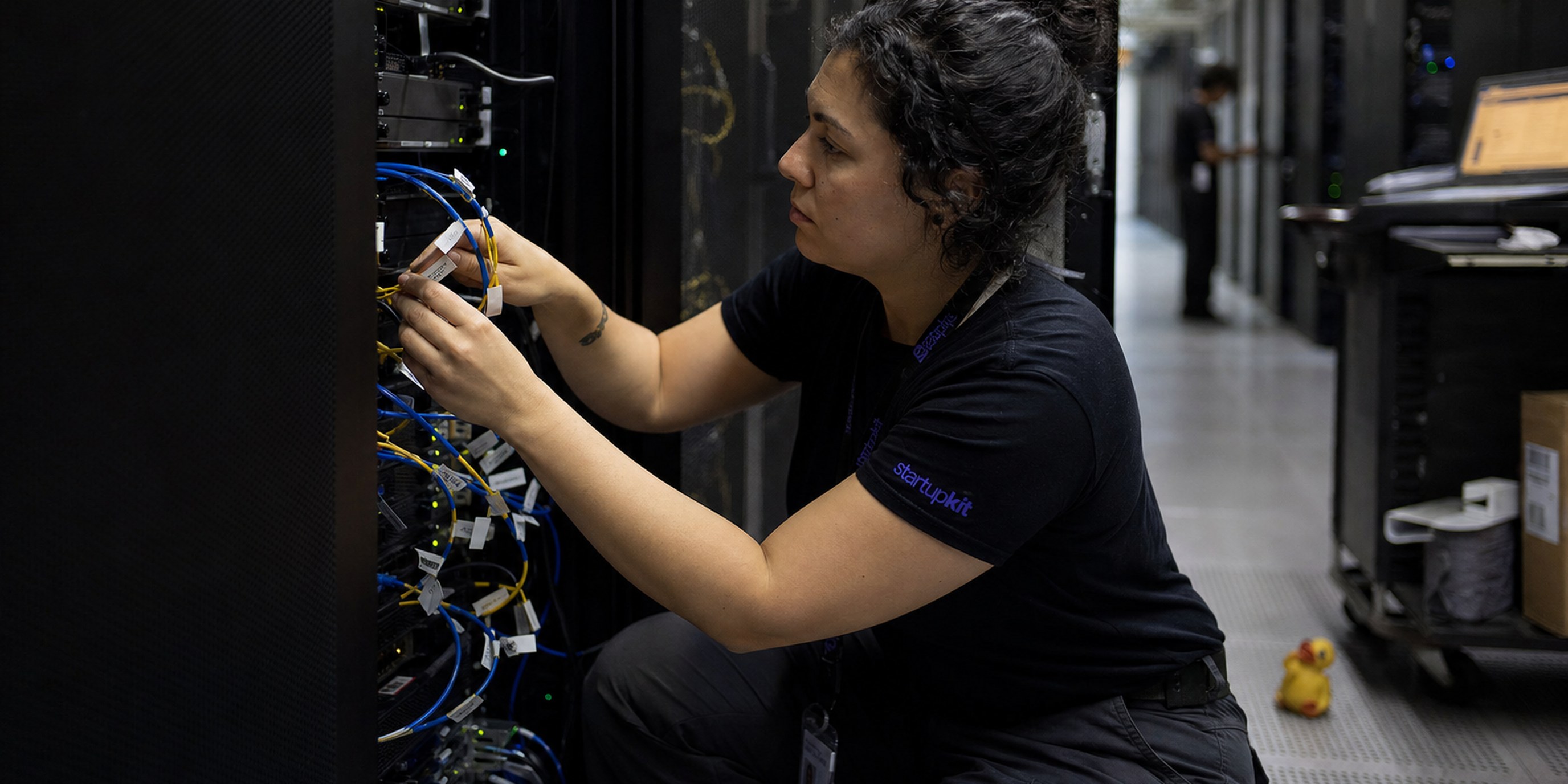
To hire a datacenter technician, write a job description that is honest about shift and on-call work, screen with a hands-on hardware-and-cabling test instead of a degree filter, prioritize systematic troubleshooting and composure under pressure, treat certifications like CompTIA Server+ and BICSI as positive signals rather than hard gates, and move fast because strong candidates collect multiple offers within days. This role is a skilled trade adjacent to electrical, HVAC, and telecom work, not a software-engineering job, and the operators who fill it quickest hire for the hands, not the diploma.
Datacenter technicians are the physical spine of the AI and cloud buildout. They rack, stack, and decommission the servers, storage, and power systems that GPU workloads run on. Demand has outrun the supply of qualified people, so the hiring problem in 2026 is not attracting applicants, it is identifying the small fraction who can do the work and signing them before a hyperscaler does. This guide covers what the role is, why it is hard to fill, what it pays, how to write the posting, which credentials matter, how to screen, and the mistakes that cost operators their best hires.
What does a datacenter technician do?
A datacenter technician keeps the physical floor of a data center running. They install and replace hardware, manage structured cabling, monitor environmental and hardware health, work tickets and runbooks, and cover shifts in a 24/7 facility. This is hands-on critical-environment work, distinct from the software roles people often confuse it with.
The day-to-day responsibilities cluster into a few areas.
- Hardware operations. Rack, stack, and decommission servers, storage, and network gear; swap failed components like drives, DIMMs, power supplies, and NICs.
- Cabling. Run, terminate, label, and document copper and fiber; maintain a clean cable plant and an accurate as-built record.
- Monitoring and first-line troubleshooting. Respond to environmental and hardware alerts; diagnose power, cooling, and connectivity issues before escalating.
- Tickets and documentation. Follow runbooks, keep asset and inventory records current, and handle smart-hands or remote-hands requests for customers and remote teams.
- Shift and on-call coverage. Staff a rotation for a facility that never goes down, and follow safety procedures including lock-out-tag-out where applicable.
Be explicit about what this role is not. A datacenter technician is not a site reliability engineer, a platform or cloud engineer, or a security analyst. Those are software-leaning roles. The technician’s value is physical execution: clean cabling, fast accurate part swaps, and calm incident response on the floor at 3 a.m. Conflating the two is the root of most hiring mistakes operators make, starting with the job description.
Why are datacenter technicians so hard to hire in 2026?
Datacenter technicians are hard to hire because demand is surging while the trained workforce shrinks and retires, and no formal degree pipeline produces them at scale. The result is a market where capable people are scarce and move quickly.
The demand side is unambiguous. LinkedIn ranked Datacenter Technician #17 on its Jobs on the Rise 2026 list of the fastest-growing US roles, naming infrastructure, operations, and cabling as the core skills and Washington D.C., Atlanta, and Columbus, Ohio as the top hiring cities (LinkedIn Jobs on the Rise 2026). Treat that as a directional signal of momentum, not a precise growth rate, since it comes from platform data rather than a government statistic. The driver is the buildout: US data center construction spending reached roughly $77.7 billion in 2025, a jump of about 190% year over year (iRecruit).
The supply side is the employer’s actual problem. The Associated Builders and Contractors trade group estimates the broader data center workforce needs around 349,000 additional workers in 2026, rising toward half a million by 2027, and notes that roughly one in four workers globally is near retirement with the pool not being replenished fast enough (Tom’s Hardware). Those figures span construction and skilled trades broadly, not technicians alone, but the direction is clear. Skilled trades have low geographic mobility, so a new AI campus can exhaust the local talent pool almost on arrival, which is why operators now treat labor as a site-selection constraint rather than an HR line item (Build.inc).
Staffing firms also report that only about 15% of applicants meet the minimum qualifications for technician roles, largely because formal degree programs for the job barely exist (talentMSH). Take that single-source figure as a warning, not gospel, but the experience it describes is common: plenty of resumes, few that clear the bar on paper, and few recruiters who can tell from a resume who can wield a screwdriver under pressure. The same forces are reshaping how startups hire across the AI buildout, a theme we cover in how to hire a forward-deployed engineer.
How much does a datacenter technician cost?
A datacenter technician costs roughly $73,000 to the high $80,000s in base salary nationally, with meaningful variance by region and seniority. Use the government wage anchor as your baseline and treat job-board aggregator numbers as directional.
The Bureau of Labor Statistics does not publish a standalone “Datacenter Technician” occupation. The closest official code is Computer Network Support Specialists (SOC 15-1231), with a median annual wage of $73,340 in May 2024 (BLS OEWS). That series shows a wide spread: the 10th percentile sits near $46,010 and the 90th above $124,470, capturing the gap between entry-level remote-hands work and senior critical-facilities specialists. The role straddles IT support and skilled-trade work, so any single code understates the range, but 15-1231 is the most defensible proxy.
Job-board aggregators put the role-specific number a bit higher, reflecting the hands-on hardware and power skills that pull above generic IT support. These are self-reported, not government data, so use them as a sanity check, not authority:
| Source | Reported figure | Type |
|---|---|---|
| BLS OEWS 15-1231 (May 2024) | $73,340 median | Government baseline |
| Salary.com (Jun 2026) | ~$79,906 average | Aggregator |
| Glassdoor (via CNBC, Mar 2026) | ~$88,000 median | Aggregator |
| Indeed (job postings) | ~$28.59/hour | Aggregator |
Geography moves the number significantly. Northern Virginia, the densest data center market in the world, carries roughly a 24% pay premium over the national average, with base salaries cited in the low-to-mid $90,000s (dcgeeks). Active buildout markets like Dallas-Fort Worth and Phoenix show upward wage pressure, and mid-tier markets such as Columbus, Salt Lake City, and Atlanta often deliver better cost-adjusted pay despite lower nominal numbers. Seniority is the other lever: break-fix entry roles sit below the median, while shift leads and power-and-cooling specialists run well above it. Plan around one reality: hyperscalers pay a cash premium smaller operators cannot match, so if you compete for the same people, you will win on speed, growth path, and a humane schedule rather than base salary alone.
How do you write a datacenter technician job description that attracts the right people?
Write a job description that tells the truth about the floor: real hardware and cabling responsibilities, plain physical requirements, and explicit shift and on-call expectations. Honesty up front is your single best retention tool, because surprises after the start date are the fastest route to a first-month quit.
Lead with the responsibilities outlined above, then state the requirements that actually predict success:
- Hands-on hardware experience: server and PC repair, builds, component-level swaps.
- Structured cabling competence and comfort reading rack and network diagrams.
- Basic networking literacy: IP, switches, ports, patch panels. CCNA-level depth is not required.
- Ticketing and ITSM familiarity, with genuine documentation discipline.
- Physical requirements stated plainly: lifting around 40 to 50 pounds, standing, ladder work.
- Explicit shift and on-call expectations, named clearly rather than buried.
Two mistakes appear in almost every weak posting. The first is a bachelor’s degree requirement. For a role with no real degree pipeline, a hard degree gate is a self-inflicted wound that rejects capable people from military, HVAC, electrical, telecom, and industrial-maintenance backgrounds. Make it nice-to-have at most. The second is scope creep. Many JD templates pad the role with sysadmin and security duties like OS patching, firewall configuration, and backups. For a true physical-ops technician, those misrepresent the job and screen out the hands-on candidates you most want. Keep the posting honest to the floor.
This is also where a generic posting quietly costs you. A trade-appropriate description needs different stages, screening, and language than a software-engineer req, and rebuilding that from scratch for every opening wastes the days that matter most. Kit’s role templates give you a pre-configured pipeline you can adapt for a technician opening in minutes, so the job description, stages, and assessment steps are aligned before the first candidate applies. If you are sourcing in a candidate-scarce market, our take on owning your hiring funnel pairs well with this.
What certifications and experience actually matter?
No license is legally required to be a datacenter technician, so the relevant credentials are skills-validating certifications. Treat the strong ones as positive signals, not hard gates, because the formal pipeline is too thin to filter on any single cert.
The credentials hiring managers ask for most often:
- CompTIA A+: hardware and OS fundamentals, the baseline break-fix cert.
- CompTIA Network+: networking fundamentals.
- CompTIA Server+: server hardware and management. Vendor-neutral, no prerequisites, well-recognized for compute-focused techs.
- Schneider Electric Data Center Certified Associate (DCCA): broad fundamentals across power, cooling, and physical infrastructure in about three days, with no prerequisites and recognition from major operators.
- BICSI Technician (TECH): the cabling-quality signal. It requires verifiable field experience plus hands-on copper and fiber training, and tells you the candidate understands standards, precision, and labeling.
- Cisco CCNA: a bonus for techs leaning into the network side, not a requirement.
Higher-level credentials like the BICSI Data Center Design Consultant (DCDC) are design and management certifications. Mention them only as a career progression path, never as a technician requirement.
Here is the reframe that separates good operators from frustrated ones: because so few people hold both certs and DC experience, the best candidates often arrive from adjacent mission-critical fields. Military maintenance, HVAC, electrical, telecom, and industrial maintenance all build the instincts the floor rewards, and those candidates can earn certs on the job (talentMSH). A useful default: weight A+, Network+, Server+, or DCCA as strong positives, BICSI as the cabling signal, CCNA as a bonus, and verifiable hands-on troubleshooting from any high-stakes environment above all of them. The same principle of valuing demonstrated skill over credentials drives how we think about hiring backend engineers.
How do you screen datacenter technicians?
Screen with a hands-on assessment, not a conversation. The highest-signal step is watching someone actually swap a part, terminate a cable, or trace a fault, because resumes do not reveal who can troubleshoot under pressure and most of your applicants will not clear the paper bar anyway.
Staffing pros favor practical assessments precisely because only a small share of applicants qualify on resume yet many can do the work (NSC/Anistar). A short bench test beats a whiteboard every time. Ask the candidate to swap a drive or power supply, terminate and test a cable run, or read a rack diagram and find the fault. You learn more in fifteen minutes of hands-on work than in an hour of behavioral questions.
Pair the bench test with a tight set of high-signal questions:
Technical and troubleshooting
- “A server won’t power on. Walk me through your diagnosis.” Look for a systematic flow: power source, PSU, connections, LEDs and POST codes, then components. Guess-and-swap is a red flag.
- “How do you test and certify a cable run?” Strong answers cover continuity, pinout, and shorts with a tester, plus attenuation and crosstalk with a certifier, with bonus points for labeling discipline.
- “What’s your first move when an environmental alarm fires at 3 a.m.?” You want triage, runbook, escalate, document, in that order.
Behavioral and temperament
- “Tell me about a time you stayed calm during a high-pressure outage.” Composure is repeatedly cited as the differentiator between good and great techs.
- “How do you feel about rotating shifts and being on-call?” Ask directly and believe the answer. Mismatches here drive first-month quits.
- “Walk me through a time you caught your own mistake or a documentation gap.” This surfaces the records-keeping habit that keeps a floor sane.
The catch with a hands-on assessment is consistency. If three interviewers grade the same bench test by gut feel, you lose the signal you just created. Score it with a structured scorecard so every candidate is rated against the same criteria, a practice with real predictive validity for hiring outcomes. Kit’s team review and voting lets every interviewer submit a structured score on the same rubric, so the decision reflects evidence rather than whoever spoke loudest in the debrief. For technical roles that warrant a deeper take-home, Kit’s code assignments integrate with GitHub, though for a pure physical-ops technician the in-person bench test remains the truer measure.
What are the biggest mistakes companies make hiring datacenter technicians?
The biggest mistakes are moving too slowly, hiding the hard parts of the job, over-filtering on degrees, and skipping the hands-on test. Each one either loses your best candidate or hires the wrong person, and all four are avoidable.
- Moving too slowly. Strong candidates collect multiple offers within days, so a six-week loop simply loses them (Broadstaff). Compress your pipeline to days, not weeks.
- Hiding the shifts, on-call, and physical demands. Surprises after the start date are the top driver of early turnover; many new hires quit in month one when the schedule wasn’t clear up front (Broadstaff).
- Over-filtering on degrees and resume keywords. With no real degree pipeline, these gates reject exactly the trade and military talent you need.
- Skipping the hands-on assessment. Resumes do not show who can troubleshoot under pressure. Always run a bench test.
- Treating technicians as interchangeable. One great technician is worth three mediocre ones in uptime and incident metrics, so hire for quality and pay to keep it.
- Padding the job description with sysadmin and security duties that misrepresent the role and deter hands-on applicants.
- No onboarding or growth path. Retention starts on day one with shadow shifts, cross-training, and a clear advancement ladder.
The speed problem deserves emphasis because it is the most common and most fixable. The math is simple: if your loop takes longer than your competitor’s, you lose, no matter how good your offer is. We made the broader case in too many interview rounds lose your best candidates, and it lands even harder for a trade where candidates are this scarce.
How do you move fast and keep them?
Speed and honesty win this market. Compress your pipeline so a qualified candidate goes from application to offer in days, then back that up with onboarding that delivers exactly the job you described. The retention levers are concrete: make the schedule real with shadow shifts so the on-call reality is lived, not promised; cross-train so technicians grow into power, cooling, or network specialties instead of stagnating in break-fix; and publish an advancement ladder so the role has a future. These fundamentals cost far less than re-running a search every quarter.
Tooling is where most of the lost days hide. Manual scheduling, scattered interviewer feedback, and slow candidate communication add up to the very weeks that send your top candidate to a hyperscaler. This is the gap Kit closes for startups and lean operators. Built-in interview scheduling removes the back-and-forth that stalls a loop. Email templates keep candidates informed so no one goes dark. Magic-link access lets tradespeople check status and respond from a phone without managing yet another password, which matters for people who are not at a desk all day. And because Kit is priced per seat, a small ops or facilities team can run a real hiring process without an enterprise budget.
For teams that want to push further, Kit is an AI-native ATS: through its MCP integration, an AI assistant can help manage the pipeline directly, summarizing candidates and surfacing the next action so your hiring manager spends time on the floor instead of in a spreadsheet. None of it replaces the human judgment of a bench test and a structured debrief. It just removes the friction that costs you the candidate.
Frequently asked questions about hiring datacenter technicians
Short, direct answers to the questions hiring managers ask most when filling this role.
What qualifications does a datacenter technician need?
No degree or license is legally required. Employers look for hands-on hardware and structured-cabling experience plus skills-validating certifications such as CompTIA A+, Network+, and Server+, the Schneider Electric DCCA, or BICSI for cabling. Verifiable troubleshooting experience from any mission-critical environment matters more than any single credential.
How much should I pay a datacenter technician in 2026?
Plan for roughly $73,000 to the high $80,000s in base salary nationally, anchored on the BLS median of $73,340 for the closest official occupation (Computer Network Support Specialists, SOC 15-1231). Northern Virginia and other dense markets carry premiums into the low-to-mid $90,000s, while seniority and power-and-cooling specialization push pay higher.
How long does it take to hire a datacenter technician?
In a candidate-scarce market the constraint is your own loop, not applicant volume. Strong candidates collect multiple offers within days, so the operators who win compress the pipeline to days rather than weeks. A six-week interview process loses your best people before you reach an offer.
Should a datacenter technician have a college degree?
No. There is no real degree pipeline for the role, so a hard degree requirement screens out exactly the military, HVAC, electrical, and telecom talent best suited to the work. Treat a degree as a nice-to-have at most and hire for demonstrated hands-on skill.
How do you test a datacenter technician’s skills in an interview?
Run a short hands-on bench test: ask the candidate to swap a drive or power supply, terminate and test a cable run, or trace a fault from a rack diagram. Score it on a consistent rubric so every interviewer rates the same criteria. Fifteen minutes of practical work reveals more than an hour of behavioral questions.
Hiring datacenter technicians, in short
Hiring a datacenter technician in 2026 comes down to four moves: tell the truth about the floor in your job description, screen with a hands-on test scored on a consistent rubric, value certifications and adjacent trade experience over a CS degree, and move fast enough to beat the hyperscalers to the offer. The qualified pool is thin and the best candidates are gone within days, so the operators who win hire for the hands and respect the people doing the work.
If you want a pipeline that supports all of that out of the box, Kit gives you adaptable role templates, structured team review, built-in scheduling, and a frictionless candidate experience, priced so a lean infrastructure team can actually use it. Start a free trial and stand up your technician hiring flow this week.
Related articles

Healthcare Bug Bounties Should Start Before a Breach
The Medyc incident shows why medical software vendors need a safe disclosure route and a funded bug bounty before someone exploits a reportable flaw.

How to Hire a Rails Engineer When AI Writes the Code
How to hire a Rails engineer for a startup: define the work, test a safe change in a real-looking app, and score judgment when AI can write the code.

AI Agent Security Incident Triage: Probe or Breach?
Use this AI agent security incident triage guide to preserve probe evidence, verify application access, contain exposure, and contact the right operator.

Human-Owned Recruiting Messages in an AI Hiring Workflow
Make recruiting messages clear and accountable when AI helps draft. Use this review guide for job ads, outreach, process updates, and rejection notes.

SSO Offboarding: A Vendor Checklist Beyond the Login
Use this SSO offboarding checklist to test existing sessions, API tokens, directory delays, and exceptions before accepting a SaaS vendor's access controls.

Leaked Credential Reports: A Practical Closure Checklist
Close a leaked credential report with evidence: remove exposure, invalidate the old secret, prevent recurrence, and document the limits of your impact review.
Try Kit for 30 days.
Hiring, security reports, and training in one account, for teams where none of it is a full-time job. Free for 30 days, card required. Cancel before it ends and you pay nothing.
Get started free