How to Hire an MLOps Engineer in 2026 (Hiring Guide)
Hire an MLOps engineer in 2026: salary benchmarks, job description, interview questions, certifications, and the modeler-vs-operator trap that wrecks hires.

Ernest Bursa
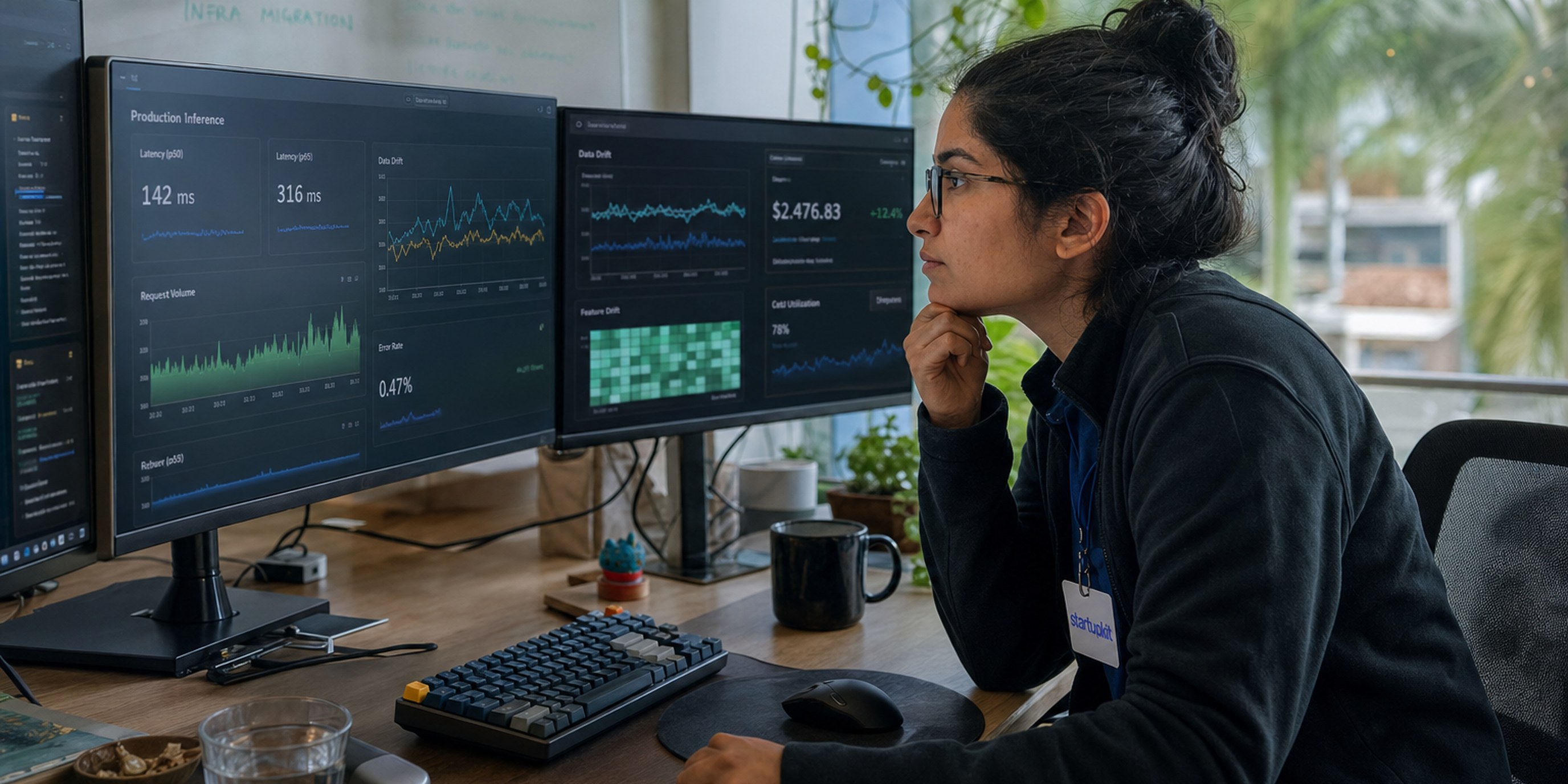
To hire an MLOps engineer in 2026, define the lane you actually need (pipeline owner, serving and reliability, or platform builder), scope production ownership and success metrics before sourcing, screen for shipped systems instead of tutorials, run an incident-based interview rather than algorithm puzzles, and benchmark compensation to the skill stack instead of the job title. The single most expensive mistake is hiring a data scientist for an operations job: MLOps is the layer that keeps models alive and affordable in production, not the layer that builds them.
This guide is for the CTO, VP of Engineering, or head of ML at a startup that has moved from “AI pilot” to “models in production” and is now bleeding reliability and cloud spend on the inference layer. You do not need an MLOps explainer. You need to tell a real production operator from someone who built a notebook pipeline, and to scope and price the role so your offer gets accepted.
How much does an MLOps engineer cost in 2026?
MLOps compensation in 2026 spans roughly $90,000 to $257,000+, with a national average base of $130,000 to $165,000. The wide band reflects three different sub-roles wearing one title, so benchmark by the skill stack you need, not the word “MLOps.”
There is no dedicated government wage code for this role. The U.S. Bureau of Labor Statistics tracks two adjacent occupations: data scientists (SOC 15-2051), with a median annual wage of $112,590 and projected 34% growth from 2024 to 2034, and computer and information research scientists (SOC 15-1221), with a median of $140,910 and 20% projected growth (BLS Occupational Outlook Handbook). MLOps pay runs above both medians because it bundles machine learning, infrastructure, and on-call duty into one person.
Here is the base-salary picture by level in 2026:
| Level | Experience | Base salary (US) |
|---|---|---|
| Entry | 0-2 yrs | $85K-$132K |
| Mid | 3-5 yrs | $115K-$175K |
| Senior | 5-8 yrs | $150K-$210K |
| Staff / Principal | 8+ yrs | $195K-$312K |
Source: KORE1 MLOps Engineer Salary Guide. Total compensation adds another 20% to 40% in equity and bonus at senior levels, and senior engineers at large platforms or frontier labs clear $300K+ all-in. Glassdoor reports an average base near $161K, with senior averages around $206K (Glassdoor).
Location still moves the number. Bay Area bases run 15% to 25% above national, New York and Seattle 10% to 20% above, and fully remote roles land 10% to 26% below a hub band.
The comp trap to avoid is benchmarking by title. KORE1 documents an employer who narrowed the band to “save” $40K, hired at $190K, and lost the person after 13 months to a $245K competing offer. Production MLOps experience commands a premium that a generic “Senior Software Engineer” band will miss every time.
What does an MLOps engineer actually do?
An MLOps engineer owns the operations layer for machine learning: serving infrastructure, CI/CD for models, monitoring, drift detection, the model registry, and inference cost. They optimize for reliability, scale, and cost of models in production, not for model accuracy. Confusing this lane with data science is the root cause of most failed hires.
The clearest way to scope the role is to put it next to its neighbors:
| Role | Owns | Optimizes for |
|---|---|---|
| Data Scientist | Model development, feature engineering, exploratory analysis | Model accuracy and insight |
| ML Engineer | Training pipelines, model optimization, deployment artifacts | Model performance and inference efficiency |
| MLOps Engineer | Serving infra, CI/CD for ML, monitoring, drift detection, model registry, cost | Reliability, scale, and cost in production |
Sources: MLOps Now, MLOps Now on ML engineers.
In practice, the core responsibilities are:
- Deploy and operate production ML services (batch scoring, online inference endpoints, streaming inference), including on-call duty (Second Talent).
- Build and maintain automated pipelines for data prep, training, retraining, and deployment (Coursera).
- Implement CI/CD for model versions so new models ship safely and bad deploys roll back.
- Resolve production incidents: silent drift, train/serve skew, degraded latency, broken data feeds, coordinating with SRE, data engineering, and product.
- Own monitoring and observability for models, with metrics, logs, and traces.
- Control inference cost: right-size serving infra, autoscale, and kill zombie endpoints.
One practitioner’s week breaks down to roughly 25% reliability, 20% serving infrastructure, 15% feature platforms, 15% CI/CD, 10% observability, and the rest in meetings and debugging. Note what is missing: building models. If your req reads like a data science job, you will hire a data scientist and your production pain will stay exactly where it is.
Why is the MLOps market so hard to hire in?
MLOps sits at a scarce intersection of machine learning and operations, and it is consistently named one of the hardest technical roles to fill in 2026. Demand has outgrown supply for three straight years as companies move from pilots to production (Axe Recruiting).
The supply problem is structural. The practitioners who have actually run these systems, managed a model registry at scale, debugged a feature pipeline silently serving stale data, or rebuilt a serving stack for 100x traffic, are a small fraction of the broader ML workforce. The World Economic Forum’s Future of Jobs Report 2025 lists AI and machine learning specialists among the three fastest-growing roles by percentage, and 86% of surveyed employers expect AI and information-processing technology to transform their business by 2030 (WEF).
The tooling market that surrounds the role tells the same story from a different angle. Analyst forecasts diverge widely, from roughly $16.6B by 2030 (Grand View Research) to a spread of $20B to $90B by 2034 (Fortune Business Insights). The exact number is contested, but every firm projects a 30% to 45% compound annual growth rate. That is the part worth internalizing: this is a candidate market, and a fast-moving one, so your process has to be tight enough not to lose people in the gap between screen and offer.
How to write an MLOps engineer job description
Write the job description after you decide which lane you are hiring for, not before. The same title hides three different jobs, and a vague req is the single biggest predictor of a search that drags from 4-7 weeks to 9-14 weeks or longer (KORE1).
Pick your lane first:
- Pipeline Owner: Airflow or Argo, MLflow, standardizing CI/CD for ML. Hire this when retraining is manual and brittle.
- Serving and Reliability: Kubernetes, Triton or KServe, autoscaling, drift and latency dashboards. Hire this when endpoints fall over or latency spikes under load.
- Platform Builder: Databricks ML, Vertex AI, or SageMaker operationalization. Hire this when you need a reusable internal platform other teams build on.
Then write requirements around the lane and, critically, around outcomes. “Come improve our ML ops” with no defined success metrics produces a hire who drifts into writing RFCs and leaves within six months. Define what “good” looks like in concrete terms: cut inference cost by a target percentage, bring p99 latency under a stated SLO, reduce endpoint mean-time-to-recovery, automate retraining for a named set of models. Keep the must-have list short and lane-specific; everything else is a nice-to-have.
For a deeper treatment of how requirement clarity affects time-to-fill, our guide on hiring a backend engineer covers the same scoping discipline for an adjacent role.
How to screen an MLOps engineer: green flags and red flags
Screen for evidence of running production systems, not for familiarity with tools. The reliable signal is specificity: numbers, named tools with versions, and quantified outcomes (KORE1).
Green flags (hire signals):
- Specific deployed-model counts (“ran 12 models in production”), not “deployed models.”
- Documented reliability wins (“reduced endpoint MTTR from 47 minutes to 9”).
- Named tools with versions: MLflow 2.x, Kubeflow Pipelines v2, KServe, Triton.
- Production on-call experience with a cited incident cadence.
- Cost wins: cut ML infrastructure spend by a quantified amount.
- Open-source contributions or conference talks in the space.
Red flags:
- Vague language: “familiar with MLflow,” “follows best practices.”
- A pure modeling resume with one Kubernetes bullet bolted on.
- Pipeline work with no scale context (how many models? how much traffic? what SLO?).
- Tutorial-grade side projects presented as production experience.
The hardest part of screening at scale is keeping the whole team anchored to these signals instead of drifting toward the candidate who “seems smart” and happens to talk fluently about model architecture. This is exactly where Kit helps: structured scorecards plus team review and voting force every interviewer to score against the operator criteria you defined, so you do not accidentally hire a data scientist by committee. Our breakdown of structured interview scorecards explains why anchored scoring outpredicts gut feel.
What interview questions should you ask an MLOps engineer?
Run an incident-based loop, not an algorithm-puzzle gauntlet. A four-round loop of about four hours works well: a platform architecture screen, a real production-incident deep-dive, a paired debugging or migration exercise on real code, and an on-call expectations and team-fit conversation (KORE1).
A loop that works:
- Platform architecture screen (45 min): decisions and rationale, not trivia. Ask why they chose a serving stack, not whether they can recite its config flags.
- Production-incident deep-dive (60 min): have them walk through an actual outage with timeline specifics. Real operators remember the timeline; tutorial builders cannot.
- Paired debugging or migration exercise (75 min): a real codebase, not a whiteboard.
- On-call expectations and team fit (45 min): be honest about pager load up front.
Sample questions that surface real experience:
- “Deploy a model to Kubernetes and manage rolling updates with minimal downtime. Walk me through it.” (DataCamp)
- “How do you detect and mitigate data drift and concept drift at scale?”
- “A production endpoint’s p99 latency just doubled. What are your first five steps?”
- “How do you version models and data so a bad deploy is reversible?”
- “Where would you cut inference cost on an over-provisioned serving stack?”
Probe tooling fluency across experiment tracking (MLflow, Weights & Biases), orchestration (Kubeflow, Airflow, Argo), serving (KServe, Triton, Seldon), and monitoring (Prometheus, Grafana, Evidently). The anti-pattern to avoid is LeetCode-style hazing. It does not predict whether someone can keep a model alive at 2 AM, and it screens out exactly the operators you want.
The paired exercise is the highest-signal round, and it is also the easiest to run badly. A live whiteboard favors confident talkers; an asynchronous, real-codebase task favors people who actually debug systems. This is where code assignments tied to GitHub earn their keep: give candidates a broken pipeline or an over-provisioned serving config and ask them to fix it on their own time, in a real repo. You see how they work, not how they perform under stage lights.
Which certifications and credentials actually matter?
There is no license for MLOps. Certifications are a tiebreaker, never a substitute for production evidence, and a candidate with three deployed models and no certs beats a candidate with three certs and no production scars.
The current, worthwhile options in 2026:
| Credential | Cost | Notes |
|---|---|---|
| AWS Certified Machine Learning Engineer – Associate | $150 | Role-based, covers SageMaker, MLflow integration, deployment, monitoring. The current AWS pick (AWS). |
| AWS Certified Machine Learning – Specialty | $300 | Exam retired on 31 March 2026. Earned certifications remain valid for three years from the award date (AWS). |
| Google Professional ML Engineer | $200 | Strongest MLOps and pipelines emphasis; Vertex AI plus BigQuery ML. Best fit for MLOps-leaning roles (Google Cloud). |
| Azure AI Engineer Associate (AI-102) | $165 (before retirement) | Certification and exam retired on 30 June 2026 (Microsoft Learn). |
Certification status updated 6 September 2026: retiring the AWS Machine Learning Specialty exam did not invalidate existing certifications. Check the candidate’s expiry date and relevant knowledge, then assess their production experience separately.
What are the most common MLOps hiring mistakes?
The most expensive mistake is hiring the modeler instead of the platform engineer. The new hire gravitates toward model work, the platform pain that triggered the requisition stays unsolved, and you are back to square one a quarter later (KORE1).
The five recurring failures:
- Hiring the modeler, not the operator. The default failure. Screen for production reliability, not model accuracy.
- Comp band too narrow. Benchmarking by title instead of skill stack costs you accepted offers and one-year retention.
- No production scope or success metrics. “Improve our ML ops” with no defined outcomes produces drift and an exit within six months.
- Mis-scoping the search. Clean searches close in 4-7 weeks; mis-scoped ones drag to 9-14 weeks. The scoping happens before sourcing, not after.
- Algorithm-puzzle interviews that filter out the operators who can actually run your systems.
Notice that four of the five mistakes are decided before a single candidate is interviewed. Get the lane, the scope, the comp band, and the interview format right up front, and the hire largely takes care of itself.
MLOps engineer hiring FAQ
Quick answers to the questions hiring managers ask most when scoping and pricing this role.
What is the difference between an MLOps engineer and a data scientist? A data scientist builds models and optimizes for accuracy and insight. An MLOps engineer owns the production operations layer (serving infrastructure, CI/CD for models, monitoring, drift detection, and inference cost) and optimizes for reliability, scale, and cost. Hiring one for the other is the most common and most expensive MLOps hiring mistake.
How much does it cost to hire an MLOps engineer in 2026? Base salaries run roughly $90,000 to $257,000+, with a national average base of $130,000 to $165,000. Total compensation adds another 20% to 40% in equity and bonus at senior levels, and senior engineers at large platforms can clear $300K+ all-in. Benchmark by the skill stack you need, not the job title.
Do MLOps engineers need certifications? No. There is no license for MLOps. Certifications such as the Google Professional ML Engineer or AWS Certified Machine Learning Engineer (Associate) are useful tiebreakers, but a candidate with shipped, production-scale systems beats one with badges and no production experience.
How long does it take to hire an MLOps engineer? A clean, well-scoped search closes in about 4-7 weeks. A vague or mis-scoped req drags to 9-14 weeks or longer. Most of the difference is decided before sourcing: pick the lane, scope the outcomes, and set the comp band first.
What interview questions reveal a real MLOps operator? Incident-based questions. Ask candidates to walk through an actual production outage with a timeline, deploy a model to Kubernetes with minimal-downtime rolling updates, detect and mitigate data drift at scale, and triage a doubled p99 latency. Real operators recall specifics; tutorial builders cannot.
Hiring for reliable, cost-controlled inference with Kit
When your models hit production, the hire is about reliability and cost control at the inference layer, and the process around that hire has to screen for operators, not modelers. The recurring pattern in failed MLOps searches is a process that drifts: a vague req, a loop built ad hoc, a team that scores on the wrong signals, and a scarce candidate lost in the gap between screen and offer.
Kit is an AI-native applicant tracking system built for startups, and it maps cleanly onto everything in this guide. Role templates like the AI / ML Engineer template give you a pre-configured pipeline so the loop (architecture screen, incident deep-dive, paired exercise, on-call fit) is set up without building it from scratch. Code assignments tied to GitHub let you run the real debugging exercise asynchronously instead of LeetCode hazing. Structured scorecards with team review and voting keep everyone anchored to the green-flag and red-flag criteria so the team does not back into a data science hire. Interview scheduling and email templates keep a fast-moving candidate engaged through the 4-7-week window where good MLOps people get poached.
For founders, the per-seat pricing means the whole hiring team can review and vote without a per-recruiter enterprise contract, and the MCP integration lets an AI assistant move candidates through the pipeline, summarize a debugging submission, or draft outreach while you focus on the technical call.
Hiring an MLOps engineer comes down to four decisions made before sourcing: pick the lane, scope the outcomes, set the comp band to the skill, and design an incident-based loop. Get those right and you stop hiring modelers for an operations job. Kit gives you the structure to run that process without inventing it from scratch every time.
Start a free trial and set up an MLOps interview loop that screens for production reliability, not whiteboard trivia.
Related articles

Healthcare Bug Bounties Should Start Before a Breach
The Medyc incident shows why medical software vendors need a safe disclosure route and a funded bug bounty before someone exploits a reportable flaw.

How to Hire a Rails Engineer When AI Writes the Code
How to hire a Rails engineer for a startup: define the work, test a safe change in a real-looking app, and score judgment when AI can write the code.

AI Agent Security Incident Triage: Probe or Breach?
Use this AI agent security incident triage guide to preserve probe evidence, verify application access, contain exposure, and contact the right operator.

Human-Owned Recruiting Messages in an AI Hiring Workflow
Make recruiting messages clear and accountable when AI helps draft. Use this review guide for job ads, outreach, process updates, and rejection notes.

SSO Offboarding: A Vendor Checklist Beyond the Login
Use this SSO offboarding checklist to test existing sessions, API tokens, directory delays, and exceptions before accepting a SaaS vendor's access controls.

Leaked Credential Reports: A Practical Closure Checklist
Close a leaked credential report with evidence: remove exposure, invalidate the old secret, prevent recurrence, and document the limits of your impact review.
Try Kit for 30 days.
Hiring, security reports, and training in one account, for teams where none of it is a full-time job. Free for 30 days, card required. Cancel before it ends and you pay nothing.
Get started free