How to Hire a Wind Turbine Technician (2026 Guide)
How to hire a wind turbine technician in 2026: verify GWO certs and WINDA IDs, screen field readiness, set pay, and run a fast safety-gated pipeline.

Ernest Bursa
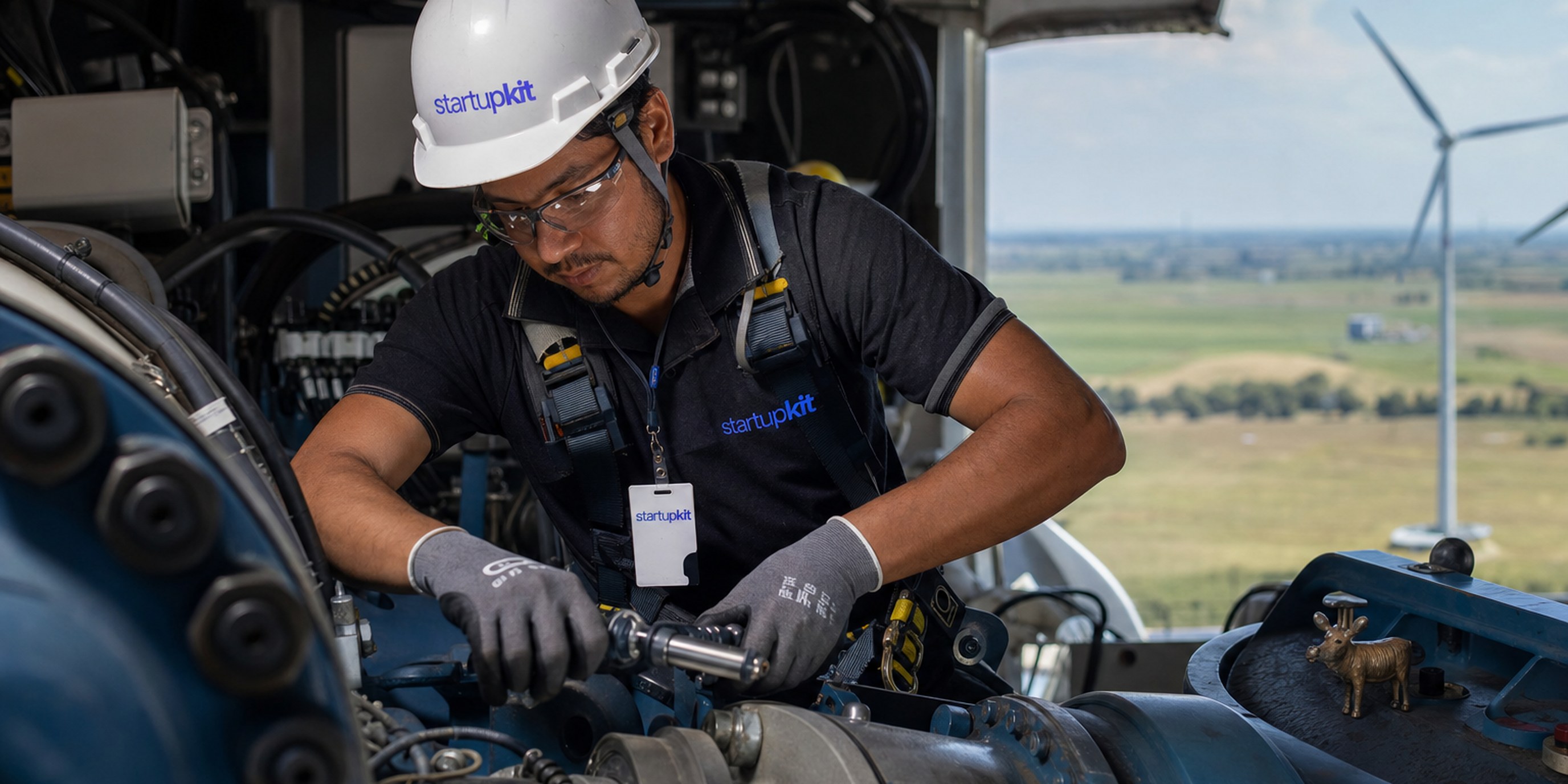
To hire a wind turbine service technician, verify GWO Basic Safety Training and a current WINDA ID, confirm comfort working at 200 to 300-plus feet, run a fitness-for-duty assessment and drug screen, and test mechanical, electrical, and hydraulic troubleshooting skills. This is the fastest-growing occupation in the United States, projected to grow 49.9 percent from 2024 to 2034 (Bureau of Labor Statistics), yet the qualified pool is tiny. You are not filtering a flood of applicants. You are competing for a few hundred people per region.
That scarcity changes everything. For most roles, the hard part is narrowing a large field. Here, the hard part is finding anyone qualified, then verifying that they can legally and physically get to the top of a turbine before you waste a full loop. Certifications and field readiness are pass/fail gates, not nice-to-haves. This guide covers the credentials, the screening signals, the interview structure, the pay, and the sourcing channels that work in a safety-critical trade.
Why is the wind turbine technician market so hard in 2026?
The wind turbine technician market is defined by a paradox: it is the single fastest-growing occupation in the country, but it sits on a microscopic base. Demand is racing ahead while the supply of certified, climb-ready people barely moves.
The Bureau of Labor Statistics projects employment to grow 49.9 percent between 2024 and 2034, from roughly 13,600 jobs to about 20,500. That is the highest projected growth rate of any occupation BLS tracks. But look at the absolute number: only about 6,800 net new jobs over a full decade. The story is scarcity, not volume. BLS estimates around 2,300 openings per year once you include replacements for people who retire or leave the trade.
When the pool is that small, every hiring inefficiency hurts. A multi-week decision gap loses your candidate to a faster OEM or independent service provider. A late-stage discovery that someone is afraid of heights burns a loop you cannot afford to repeat. Industry staffing firms report annual turnover above 25 percent for technical renewables roles (iRecruit), which means the same operators are perpetually re-hiring against the same thin bench.
The work itself filters hard. Technicians climb to the nacelle and perform scheduled and unscheduled maintenance at 200 to 300 feet or more, often in confined spaces and adverse weather. Many sites enforce a two-person rescue rule, so a single vacant seat can take a whole crew offline. You are hiring for a job most people cannot or will not do.
What should you look for in a wind turbine service technician?
Look for three things that map directly to whether someone can do the job safely on day one: field readiness at height, hands-on mechanical and electrical competence, and a genuine safety mindset. A degree is not one of them.
Field readiness at height
This is the silent disqualifier. Comfort and competence at extreme heights is non-negotiable, and so is the ability to work in the confined space of a nacelle. Fear of heights, claustrophobia, and inability to pass a fitness-for-duty assessment are the failures that surface late and waste the entire pipeline. Screen for them early, before anyone schedules a climb day.
The physical bar is real and regulated. AWEA (now the American Clean Power Association) Fitness for Work guidelines state that anyone who climbs must be in good physical condition and free of conditions that add rescue risk, with self-assessment plus medical screening as standard practice. OSHA fall-protection rules kick in at six feet for construction and installation work and four feet for general industry maintenance. This is a life-safety role governed by hard thresholds, not a preference.
Mechanical, electrical, and hydraulic skill
Technicians diagnose and repair faults across the drivetrain, hydraulics, and electrical systems, then collect turbine data and replace worn components like bearings and gearbox parts. The skills employers consistently list:
- Mechanical aptitude on drivetrains, bearings, gearboxes, and torque or bolt-tightening procedures
- Electrical and hydraulic troubleshooting, reading schematics, and using multimeters, insulation testers, and vibration analyzers
- Communication and teamwork, because two-person crews depend on each other for rescue
Safety mindset
In a trade where a mistake at 250 feet is fatal, the willingness to stop a job is a feature, not a flag. Look for candidates who treat lockout/tagout as muscle memory and who can describe a time they halted work over a safety concern. A culture of stop-work authority starts with who you hire.
What certifications and licensure are required to hire a wind turbine technician?
Certifications are the non-negotiable gates in wind technician hiring. The dominant standard is GWO (Global Wind Organisation) Basic Safety Training, and most sites will not grant access without it. Treat credentials as pass/fail checks you verify, not paperwork you collect.
GWO Basic Safety Training and WINDA
GWO Basic Safety Training (BST) is the de facto requirement to access most wind sites. The onshore stack covers four modules: Working at Heights, First Aid, Manual Handling, and Fire Awareness. Offshore work adds a fifth module, Sea Survival. Many technician roles also expect GWO Basic Technical Training (BTT), which covers mechanical, electrical, and hydraulic fundamentals plus installation and bolt-tightening.
Two details matter most for hiring:
- Validity is 24 months. Certifications expire on a rolling clock, and a lapsed cert means a technician cannot get site access. This is a recurring compliance burden, not a one-time check, and it applies to your existing crew too.
- Verify the WINDA ID, not the PDF. GWO records live in the WINDA database, each tied to a unique WINDA ID. Ask for the WINDA ID and confirm the record. Do not accept a printed certificate at face value.
Other credentials to screen for
| Credential | Status | Notes |
|---|---|---|
| GWO BST (4 modules onshore, 5 offshore) | Hard gate | Required for site access; 24-month validity |
| Valid WINDA ID | Hard gate | Verify the record, not the certificate |
| Fitness-for-duty + drug screen | Hard gate | Life-safety requirement; near-universal in postings |
| Valid driver’s license | Hard gate | Remote sites; travel between farms |
| OSHA 10 / OSHA 30 | Commonly listed | General industry or construction safety card |
| GWO Basic Technical Training | Often expected | Mechanical, electrical, hydraulic fundamentals |
| OEM platform certs (Vestas, Siemens Gamesa, GE Vernova) | Usually trainable | Platform-specific levels, often trained post-hire |
One more credential note: BLS lists the typical entry path as a postsecondary certificate, usually a one to two-year wind-tech program at a community or technical college, plus on-the-job training. A four-year degree is not required, and requiring one shrinks an already tiny pool for no benefit.
How do you write a wind turbine technician job description?
Write the job description to separate hard gates from trainable skills, and to state the realities of travel and location up front. Vague requirements either scare off qualified people or pull in candidates who drop out late.
Separate gates from trainables. Hard gates are GWO BST, climb readiness, a clean drug screen, and a valid driver’s license. Trainable items include specific OEM platform certifications and advanced blade repair. Listing OEM-specific certs as hard requirements in a pool of about 13,600 people unnecessarily shrinks your field. Train those post-hire.
State onshore versus offshore explicitly. Offshore work means GWO Sea Survival, a bigger rotation and travel commitment, and a meaningful pay premium. Burying this causes mismatches.
Be concrete about logistics. Spell out the travel percentage, the rotation schedule, and the home base. The job is geographically concentrated in wind corridors like Texas, Iowa, Oklahoma, and the broader Midwest, with emerging offshore work on the East Coast. Willingness to travel or relocate is a deal-breaker that belongs at the top of the posting, not in the fine print.
A clean structure also gives every reviewer the same yardstick. Sloppy or inflated requisitions are a known driver of slow, scattershot hiring, a problem we cover in how vague requirements stretch time-to-fill. For a safety-critical trade, that clarity is the difference between a candidate who self-selects in and one who washes out on climb day.
How much does a wind turbine technician make in 2026?
The national median wage for wind turbine service technicians was $62,580 per year, or about $30.09 per hour, as of May 2024 (BLS, SOC 49-9081). But the median masks a wide spread by geography, seniority, and onshore versus offshore work, so treat it as a starting anchor rather than a target.
Here is how the range tends to break down, with the caveat that anything beyond the BLS median comes from salary aggregators (Salary.com, Research.com) and should be read as an estimate:
| Level | Typical range | Source quality |
|---|---|---|
| Entry-level | $49,000 to $55,000 | Aggregator estimate |
| 5-plus years | $70,000 to $90,000 | Aggregator estimate |
| Lead / specialized / offshore | $100,000-plus | Aggregator estimate |
Geography moves the number significantly. Salary.com lists the highest-paying states as the District of Columbia (around $96,000), California (around $95,600), Massachusetts (around $94,400), Washington (around $94,000), and New Jersey (around $94,000), with the lowest in South Carolina, West Virginia, Kentucky, Louisiana, and Mississippi.
The practical takeaway: do not benchmark a Texas onshore role against a Massachusetts offshore role and expect the same candidate response. In a scarcity market, your offer has to be competitive for the specific region and the specific platform, because the few qualified people in that corridor have options. Compare BLS and regional sources with advertised salary data in Kit. The latter provides quartiles and medians of advertised lower bounds, normalized monthly. Adapt your offer to the local market.
How should you structure the interview process?
Structure the interview around three signal areas: safety judgment, diagnostic reasoning, and field fit. Keep it short. In a market with about 2,300 openings a year chasing the same small pool, a slow process loses people to faster competitors.
Safety and behavioral. These reveal whether the candidate treats safety as identity, not compliance theater.
- Walk me through your lockout/tagout procedure before working on a turbine.
- A teammate freezes 250 feet up. What do you do?
- Describe a time you stopped a job over a safety concern.
Technical and diagnostic. These test whether the candidate can actually reason through a fault.
- A turbine throws a pitch-system fault and stops producing. How do you troubleshoot, from the data down through hydraulics and electrical isolation?
- How do you read a vibration analysis report to catch a failing bearing early?
- Walk me through torquing a bolt to spec, and explain why bolt tension matters on a tower.
Field fit. These surface the practical realities that cause attrition.
- How do you handle 12-hour days, remote sites, and weeks of travel?
- Are you comfortable in the confined space of a nacelle?
- Which OEM platforms have you serviced, and at what certification level?
One structural decision matters more than the questions: who signs off. Safety judgment is too consequential to rest on one recruiter’s read. Have multiple crew leads evaluate the same candidate against the same criteria. Anchored, independent scorecards predict on-the-job performance far better than gut feel, and they make a safety-critical hire a collective decision rather than one person’s bet.
Resist the urge to add rounds. Every extra stage in a scarcity market is a chance for your candidate to accept somewhere else, a pattern we unpack in why too many interview rounds lose your best candidates.
Where do you source wind turbine technicians?
Source from a mix of OEMs, independent service providers, staffing benches, and the technical-college pipeline, concentrated in the wind corridors where the work is. With a pool this small, inbound applications alone will not fill the seat. The main channels:
- OEMs and their service arms. Vestas, Siemens Gamesa, and GE Vernova hire onto their own platforms and run their own certification levels. They are both a talent source and your fiercest competition.
- Utility-scale operators. NextEra Energy, Ørsted, Duke Energy, EDF Renewables, and others run large fleets and large benches.
- Independent service providers (ISPs). Firms like Sky Climber Renewables, cited as the largest privately held utility-scale wind contractor with 700-plus team members, employ deep pools of cross-platform techs.
- Staffing firms. National staffing benches pre-vet for GWO certs, LOTO adherence, climb readiness, and safety history, and can supply within 24 to 72 hours once site compliance clears.
- Technical colleges. One to two-year wind-tech programs are the primary entry pipeline. Build relationships with them for junior hires you train up.
The global backdrop underlines the urgency. GWO has projected a need for roughly 628,000 wind technicians worldwide by 2030 (a directional advocacy figure, not a precise forecast). The direction is clear: demand outpaces supply, and the operators who source proactively win.
Kit supports job distribution through available integrations. AI outreach also helps prepare campaigns for technicians who are not actively job hunting. Combine these channels with relationships with local schools and companies.
What are the most common hiring mistakes to avoid?
The most common mistakes all share a root cause: treating a safety-critical, scarcity-market hire like an ordinary one. Each one costs you a candidate, a climb day, or a compliance gap.
- Treating certs as paperwork instead of gates. Not verifying the WINDA ID or GWO expiry, then discovering on day one that the tech cannot get site access.
- Screening field readiness too late. Fear of heights or a failed fitness-for-duty assessment surfacing after a full loop instead of at the start.
- Over-specifying OEM platform certs as hard requirements in a pool of about 13,600 people, instead of training them post-hire.
- Vague travel and relocation expectations that cause late dropouts in a geographically concentrated job.
- A slow process that loses candidates to faster OEMs and ISPs in a 2,300-openings-a-year market.
- Ignoring the 24-month recertification clock for your existing team, creating future site-access gaps you did not see coming.
That last point is worth dwelling on. The same expiry clock that gates new hires also threatens your current crew. A tech whose GWO cert lapses next quarter is a turbine you cannot service next quarter. Most operators only notice it when access is already blocked.
How does Kit help you run a safety-gated hiring pipeline?
Kit lets teams prepare recruiting stages and record verification findings. The team remains responsible for checking credentials, fitness for work and required training. The system does not independently verify GWO certificates or authorize a candidate to work on a turbine.
Here is how the pieces map to the realities above:
- Role templates provide stages for interviews and assessments, which you can adapt to recording credential checks for your sites. Start from the Skilled Trades Technician template.
- Structured assessment stages let you capture the practical and diagnostic screen (the same drivetrain, hydraulics, and electrical reasoning you test in the interview) as a recorded stage, not a hallway conversation. The same machinery Kit uses for GitHub-integrated code assignments works as a generic structured assessment for any trade.
- Team review and voting put multiple crew leads on the same anchored scorecard, so safety judgment is a collective sign-off rather than one recruiter’s call.
- Interview scheduling coordinates scattered field crews and traveling candidates without the back-and-forth that costs you days you do not have.
- Magic links and email templates keep candidates warm in a fast scarcity market and give field techs passwordless access from the phone they actually live on.
- AI outreach proactively sources the tiny passive pool instead of waiting on inbound.
- MCP integration lets an AI assistant help manage recruitment, including summarizing available information and changing candidate stages. Track employee certificate renewals in your training register; do not assume the assistant has complete certification records.
You can request a WINDA ID during a recruiting stage and record the result of a certificate check. Your team performs the WINDA verification, without an automatic connection from Kit. Kit also provides advertised salary data and job distribution through available integrations.
Frequently asked questions about hiring wind turbine technicians
Short answers to the questions employers ask most when hiring wind turbine service technicians.
What certifications does a wind turbine technician need?
Most sites require GWO Basic Safety Training, which covers four modules onshore (Working at Heights, First Aid, Manual Handling, Fire Awareness) and a fifth offshore (Sea Survival). Each cert is tied to a WINDA ID and is valid for 24 months. Many roles also expect GWO Basic Technical Training and OEM platform certs that are usually trained post-hire.
How much does it cost to hire a wind turbine technician?
The BLS median wage was $62,580 per year (about $30.09 per hour) as of May 2024. Entry-level pay tends to run $49,000 to $55,000, experienced techs $70,000 to $90,000, and lead, specialized, or offshore roles $100,000-plus, with the higher figures coming from salary aggregators. Geography moves the number significantly, so benchmark to the specific corridor and platform.
Do you need a degree to be a wind turbine technician?
No. BLS lists the typical entry path as a postsecondary certificate, usually a one to two-year wind-tech program at a community or technical college, plus on-the-job training. Requiring a four-year degree only shrinks an already tiny candidate pool.
How long does it take to hire a wind turbine technician?
There is no fixed benchmark, but speed is the deciding factor. With roughly 2,300 openings a year chasing the same small pool, a multi-week decision gap loses candidates to faster OEMs and independent service providers. Pre-vetted staffing benches can supply within 24 to 72 hours once site compliance clears.
How do you verify a wind turbine technician’s GWO certification?
Ask for the candidate’s WINDA ID and confirm the record in the WINDA database rather than accepting a printed certificate. Check the expiry date too, because the 24-month clock means a lapsed cert blocks site access on day one.
Hiring wind turbine technicians is the inverse of most hiring. The constraint is not too many applicants, it is too few qualified, climb-ready people, and the cost of advancing the wrong one is measured in safety, not just time. Verify the gates early, keep the process fast, and make the safety call a team decision. To prepare shared recruiting stages, start a free trial.
Related articles

Healthcare Bug Bounties Should Start Before a Breach
The Medyc incident shows why medical software vendors need a safe disclosure route and a funded bug bounty before someone exploits a reportable flaw.

How to Hire a Rails Engineer When AI Writes the Code
How to hire a Rails engineer for a startup: define the work, test a safe change in a real-looking app, and score judgment when AI can write the code.

AI Agent Security Incident Triage: Probe or Breach?
Use this AI agent security incident triage guide to preserve probe evidence, verify application access, contain exposure, and contact the right operator.

Human-Owned Recruiting Messages in an AI Hiring Workflow
Make recruiting messages clear and accountable when AI helps draft. Use this review guide for job ads, outreach, process updates, and rejection notes.

SSO Offboarding: A Vendor Checklist Beyond the Login
Use this SSO offboarding checklist to test existing sessions, API tokens, directory delays, and exceptions before accepting a SaaS vendor's access controls.

Leaked Credential Reports: A Practical Closure Checklist
Close a leaked credential report with evidence: remove exposure, invalidate the old secret, prevent recurrence, and document the limits of your impact review.
Try Kit for 30 days.
Hiring, security reports, and training in one account, for teams where none of it is a full-time job. Free for 30 days, card required. Cancel before it ends and you pay nothing.
Get started free