How to Hire an HVAC Technician: A 2026 Hiring Guide
Hire an HVAC technician in 2026: salary benchmarks, EPA 608 screening, interview questions, and how to win techs fast in a tight labor market.

Ernest Bursa
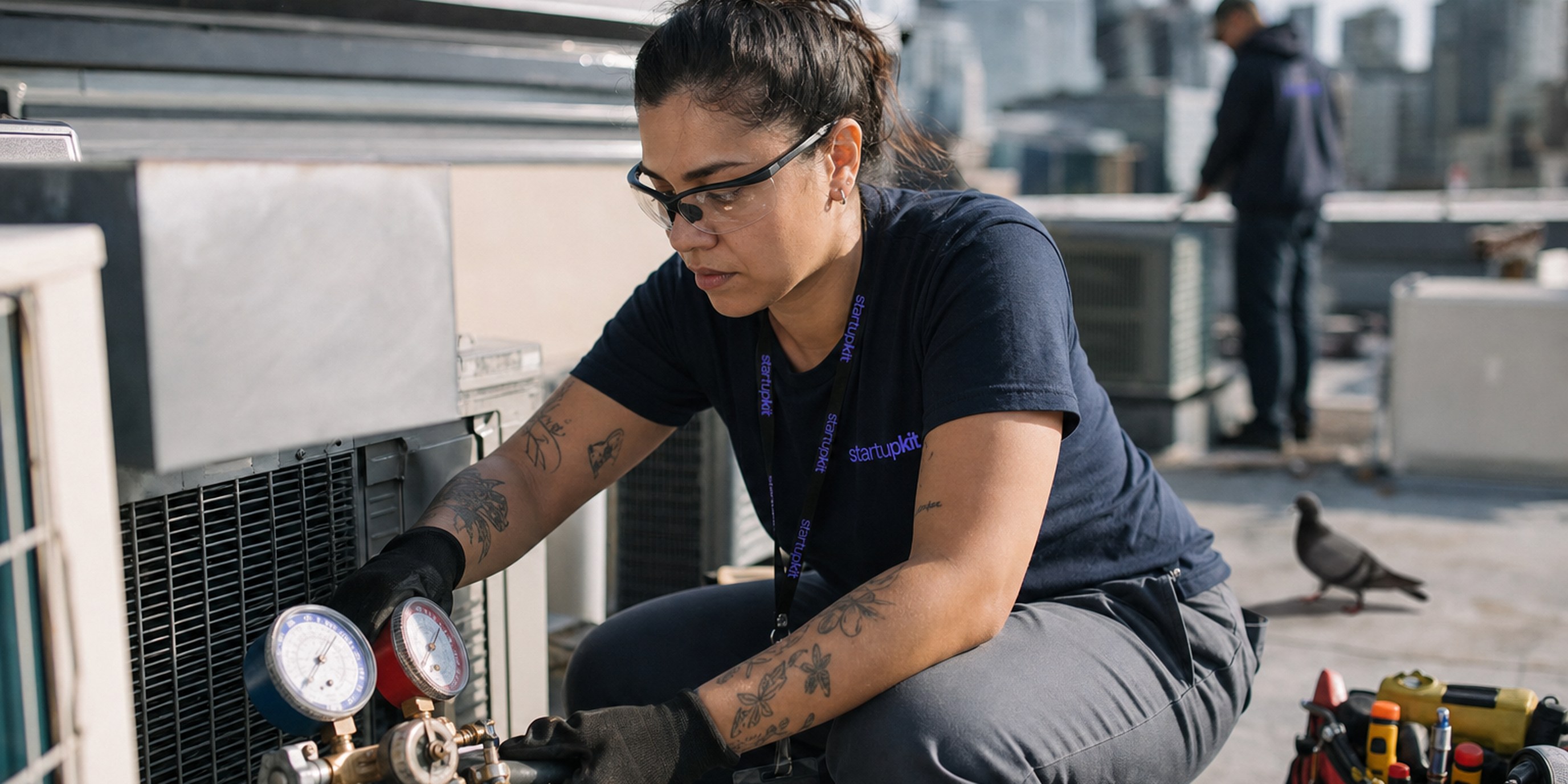
To hire an HVAC technician, write a job description with a posted pay range, screen first for EPA Section 608 certification, verify diagnostic skill with a hands-on scenario, and move fast. The median HVAC technician earns about $59,810 a year (BLS, May 2024), postings stay open around 31 days, and qualified techs field multiple offers at once. The shops that win treat speed and a clear credential gate as the whole game.
This guide walks through the full hiring playbook: why the market is so tight, what to budget, which certifications are non-negotiable, how to screen for real field readiness, and the mistakes that quietly drain your funnel.
Why are HVAC technicians so hard to hire in 2026?
The short answer: demand is climbing while the experienced workforce retires faster than new techs enter the trade. The U.S. Bureau of Labor Statistics projects 8% employment growth for heating, air conditioning, and refrigeration mechanics and installers from 2024 to 2034, “much faster than average,” with roughly 40,100 job openings per year over the decade, many of them from retirements and transfers rather than new positions.
The pipeline problem is structural. A large share of the current HVAC workforce is over 45 and approaching retirement, and too few younger workers are entering to replace them. ServiceTitan, citing this demographic squeeze, has described a current deficit on the order of 110,000 technicians with roughly 25,000 leaving the field annually. Treat those figures as a vendor estimate rather than a census number, but the direction is not in dispute.
Demand is spiking at the same time. Labor-market data aggregator JobsPikr reported roughly 87,400 active HVAC postings in Q1 2026 with a median posting duration near 31 days, about twice as long as comparable tech or healthcare roles take to fill. Randstad’s data, covered by Fortune in March 2026, found HVAC-related postings up 67% since late 2022. McKinsey analysis cited in that coverage put skilled-trade demand at roughly 20 openings for every one new worker entering through 2032.
What this means for you as a hiring manager: you are not competing on whether to hire, you are competing on how fast and how clearly. A candidate who clears your screen has likely cleared two others. The shop with a tight, posted pay range and a two-day callback wins the tech that the four-week interview loop loses.
What does an HVAC technician actually do?
An HVAC technician installs, diagnoses, repairs, and maintains heating, ventilation, air conditioning, and refrigeration systems in homes and businesses. The scope varies a lot by segment, and that distinction should drive your job description before anything else.
The role splits along a few axes worth naming in the posting:
- Residential vs. commercial. Residential techs handle furnaces, split systems, heat pumps, and homeowner-facing service calls. Commercial and light-commercial techs work on rooftop units, larger chillers, and building systems, often with more electrical and controls complexity.
- Install vs. service. Installers fit new equipment and ductwork. Service techs diagnose failures, recover and recharge refrigerant, and keep existing systems running. Many shops want both; few candidates are equally strong at each.
- Maintenance vs. diagnostic. Preventive maintenance is checklist work. True diagnostic skill, tracing an intermittent fault back to a failing capacitor or a refrigerant charge issue, is rarer and worth paying for.
A good job description names the segment, the equipment types, the on-call expectation, and the truck and tool policy. The fields that actually move applications are concrete: pay range, take-home truck or not, on-call rotation frequency, and benefits. Vague postings that lead with “competitive pay” and “fast-paced environment” get skipped by exactly the techs you want.
If you do not have a structured posting yet, Kit’s Skilled Trades Technician template gives you a pre-configured pipeline to start from, so you are editing a real hiring flow instead of staring at a blank page. More on that below.
What is the HVAC technician salary in 2026?
The national median wage for HVAC mechanics and installers is about $59,810 a year, or roughly $28.75 an hour, per BLS data for May 2024. The bottom 10% earn under about $39,130, and the top 10% earn over about $91,020. That spread is the important part: a single national median is not a hiring rate for your market.
Three forces move the number well off the median:
| Factor | Range | Source |
|---|---|---|
| Geography | Alaska ~$80,940/yr vs. Mississippi ~$45,710/yr | Housecall Pro / ServiceTitan, citing BLS state data |
| Seniority | Entry ~$39,000-$45,000 vs. senior/commercial (5+ yrs) ~$70,000-$80,000+ | BDR; ServiceTitan |
| Union status | Union ~$72,210 vs. non-union ~$58,782 (~23% gap, before benefits) | ServiceTitan salary guide (secondary) |
A quick warning on a common data error: some sources quote a “$49,500 median” for HVAC. That figure is the BLS median for all occupations, the comparison baseline, not the HVAC number. Budget against $59,810 nationally, then adjust up or down for your state, segment, and the seniority you actually need.
Certification also carries a wage premium. NATE-certified technicians earn roughly 12.2% more on average, according to data compiled by Interplay Learning. A widely repeated estimate puts the gap closer to $15,000 a year, though that figure circulates mostly through vendor blogs, so treat the 12.2% as the firmer number and the $15k as a softer ceiling.
The pay range belongs in your posting. It is one of the single biggest factors in whether a qualified tech clicks “apply,” and omitting it is the fastest way to throttle your own funnel in a market where candidates are comparing offers in real time.
Which certifications and licenses should you screen for?
EPA Section 608 certification is the hard gate. Everything else is a quality signal. Screen for 608 first, because hiring a tech to handle refrigerant without it exposes your business to federal liability under the Clean Air Act.
EPA Section 608 (the non-negotiable)
Section 608 of the Clean Air Act federally requires certification to maintain, service, repair, or dispose of equipment that could release ozone-depleting or HFC refrigerants. It comes in four flavors, and the type matters:
- Type I covers small appliances (5 lb of refrigerant or less).
- Type II covers high and very-high-pressure systems, which is most residential and light-commercial AC. This is the one most service techs need.
- Type III covers low-pressure systems like large chillers and industrial equipment.
- Universal combines Core plus Types I, II, and III, letting a tech legally work across all categories.
A tech earns it by passing a Core exam plus at least one Type exam through an EPA-approved certifying organization. Critically, the certification does not expire, so you are verifying a credential the candidate holds for life, not one that lapses. Ask for the type and confirm it matches the work. A Type I holder cannot legally service the residential split systems most of your calls involve.
NATE certification (the quality signal)
NATE certification is not legally required, but it is the strongest single quality and retention signal you can screen for. The data, compiled by Interplay Learning from Zmags and NATEX sources, is consistent: 79% of contractors want their techs NATE-certified, 76% say certified techs are better prepared, and NATE-certified techs complete roughly 20.5% more work on average. Telling against the skeptics, Interplay reports that 55% of callbacks (return visits to fix incomplete work) involve techs without NATE certification.
NATE also helps you keep people. Three of four techs are more likely to stay when their employer funds NATE training, per the same data. Funding certification is one of the cheapest retention levers available, and skipping it is an own-goal in a market this tight.
The rest of the checklist
- Valid driver’s license, usually with a clean record, since techs drive company trucks.
- State or local HVAC license where required. Some states license HVAC work, some do not, so verify your local rules rather than assuming.
- A2L refrigerant familiarity. Newer low-GWP refrigerants like R-454B and R-32 are mildly flammable, and A2L-aware training is increasingly relevant for 2026 equipment. Treat it as an emerging plus, and confirm real exposure rather than a line on a resume.
What interview questions and screening steps actually reveal a good tech?
A resume proves nothing about whether someone can diagnose a no-cooling call or talk a frustrated homeowner off the ledge. The shops that hire well replace resume-only screening with a short, scenario-based process that tests reasoning and customer manners directly. Both ServiceTitan and relayfi recommend exactly this kind of two-to-three-stage structure.
The screening process that works
- Application plus credential gate. Capture EPA 608 type, license, and years of experience up front. Anyone who fails the gate stops here.
- 20-minute phone screen. Confirm certifications, schedule and on-call availability, and pay expectations. This catches misalignment before anyone invests an hour.
- Shop or field scenario (15-30 minutes). Hand them a realistic failure or an install walk-through. This is the step most shops skip and the one that separates real techs from good talkers.
- Team review and final. A culture and reliability check with the people they will actually work alongside.
Questions and scenarios that surface real skill
The goal is to watch how a candidate reasons, not whether they memorized an answer. Use prompts like:
- Diagnostic reasoning: “No cooling, the compressor runs, suction pressure is low. Walk me through your first three checks.” You are listening for a logical sequence, not a single correct guess.
- Refrigerant discipline: “Walk me through your recovery procedure on a system you are about to replace.” This ties straight back to EPA 608 and tells you whether they vent or recover.
- Electrical competence: Ask them to talk through reading a schematic, using a multimeter, and a safe lockout sequence.
- Customer readiness: “A homeowner is angry the repair cost more than the quote. What do you say?” Field techs are the brand. A tech who cannot de-escalate costs you reviews and repeat business.
- Tech literacy: Comfort with mobile field-service apps and digital work orders is now table stakes.
For the team review stage, getting the owner and the service manager aligned quickly matters as much as the questions themselves. Kit’s team review and voting lets both weigh in on a candidate without a meeting, which keeps a two-offer candidate from going cold while you chase calendars.
What are the most common HVAC hiring mistakes?
Most failed HVAC hires trace back to a handful of repeatable mistakes. None are exotic, which is exactly why they keep happening.
- Hiding the pay range. Omitting it is the single biggest funnel killer. Qualified techs filter it out and move on.
- Treating EPA 608 as a nice-to-have. It is a federal requirement. Gate on it, and confirm the type matches the work.
- Resume-only screening. A PDF does not prove diagnostic skill or customer manners. Skip the hands-on step at your peril.
- A slow process in a fast market. With a ~31-day median posting duration and techs holding multiple offers, a multi-week loop loses people to faster competitors. Speed is a feature, not a luxury, and too many interview rounds is how shops lose the best techs.
- Ignoring seasonality in the offer. Techs leave when shoulder-season hours and paychecks drop. Address income stability up front or watch early attrition climb.
- Forgetting the non-pay levers. Take-home truck, on-call frequency, flat-rate vs. time-and-materials, and signing bonuses all weigh heavily in a tech’s decision.
- Not funding certification. Employers who fund NATE and training see materially higher retention; Interplay Learning links structured employer-funded training to roughly 34% higher retention.
- Over-relying on generic job boards. Trade-specific channels and referrals outperform: referral hires retain at roughly 46% versus about 33% for online-job-post hires, per relayfi and ServiceTitan data. (More on why it pays to own your hiring funnel instead of renting reach.)
The cost of getting it wrong is real. Industry estimates compiled by Interplay Learning put the cost of losing a technician at 100-150% of their salary once you count recruiting, onboarding, and retraining. At a $60,000 wage, a single bad hire can quietly cost you $60,000 to $90,000.
How can you hire HVAC technicians faster with Kit?
Speed and a clean credential gate are the two things that decide HVAC hires in 2026, and they are exactly what a structured pipeline is built to give you. Kit is an AI-native applicant tracking system designed for small teams that do not have an HR department, which describes most HVAC shops.
Here is how the pieces map to the problems above:
- Role templates spin up a pre-configured hiring pipeline so you are not building stages from scratch. Edit the EPA 608 gate, the phone screen, and the field-readiness stage, and you are live.
- A credential-gated application captures EPA 608 type, license, and experience on the way in, so uncertified candidates are filtered before they reach your service manager.
- Magic links give candidates passwordless access. A tech can apply and respond from a phone between calls, no account or password to remember, which matters when your applicants are in the field.
- Team review and voting lets the owner and service manager align on a candidate asynchronously, so the decision does not wait on a meeting.
- Interview scheduling is built in, cutting the back-and-forth that lets fast competitors get there first.
- Email templates keep candidates warm between stages, the simplest defense against ghosting in a market where techs are juggling offers.
- MCP integration means you can point an AI assistant at your pipeline to summarize candidates, draft follow-ups, or surface who is waiting on you, without leaving the tools you already use.
And because Kit uses per-seat pricing, a shop pays for its team users, not its trucks or open roles. Kit also includes job distribution options and compensation research based on advertised ranges; check the available destinations and relevant salary sample before relying on them.
Frequently asked questions about hiring HVAC technicians
Short, direct answers to the questions hiring managers ask most when staffing an HVAC shop in 2026.
How much does it cost to hire an HVAC technician? Budget against a national median wage of about $59,810 a year (roughly $28.75/hour, BLS May 2024), then adjust for your state, segment, and seniority. The bigger hidden cost is a bad hire: industry estimates compiled by Interplay Learning put the cost of losing a technician at 100-150% of salary once recruiting, onboarding, and retraining are counted, so $60,000 to $90,000 on a $60,000 wage.
Is EPA 608 certification required to hire an HVAC technician? Yes, for any tech who handles refrigerant. Section 608 of the Clean Air Act federally requires certification to maintain, service, repair, or dispose of refrigerant-containing equipment. Screen for the right type (Type II covers most residential and light-commercial AC) and note the certification does not expire.
How long does it take to hire an HVAC technician? HVAC postings stay open around 31 days on average (JobsPikr, Q1 2026), roughly twice as long as comparable tech or healthcare roles. Because qualified techs often hold multiple offers, the shop with a posted pay range and a fast callback usually wins.
What is the difference between EPA 608 and NATE certification? EPA 608 is a legal requirement to handle refrigerant. NATE is a voluntary quality credential: it is not required, but NATE-certified techs complete roughly 20.5% more work on average and earn about 12.2% more, according to data compiled by Interplay Learning. Gate on 608; treat NATE as a strong quality and retention signal.
What questions should you ask in an HVAC technician interview? Use scenario-based prompts that test reasoning, not memorization: a no-cooling diagnostic walk-through, a refrigerant recovery procedure (tied to EPA 608), reading a schematic and using a multimeter safely, and a customer de-escalation scenario. Pair the questions with a 15-30 minute hands-on shop or field scenario.
The bottom line
Hiring an HVAC technician in 2026 comes down to four moves: post a real pay range, gate hard on EPA 608, test field readiness with a hands-on scenario instead of trusting the resume, and move faster than the shop across town. The median tech earns about $59,810, the market is tight, and the candidate who clears your screen has already cleared someone else’s.
A structured pipeline is what turns those four moves into a repeatable process instead of a scramble every time a truck sits empty. If you want to run it that way, start a free trial and build your HVAC pipeline from the Skilled Trades Technician template in an afternoon.
Related articles

Healthcare Bug Bounties Should Start Before a Breach
The Medyc incident shows why medical software vendors need a safe disclosure route and a funded bug bounty before someone exploits a reportable flaw.

How to Hire a Rails Engineer When AI Writes the Code
How to hire a Rails engineer for a startup: define the work, test a safe change in a real-looking app, and score judgment when AI can write the code.

AI Agent Security Incident Triage: Probe or Breach?
Use this AI agent security incident triage guide to preserve probe evidence, verify application access, contain exposure, and contact the right operator.

Human-Owned Recruiting Messages in an AI Hiring Workflow
Make recruiting messages clear and accountable when AI helps draft. Use this review guide for job ads, outreach, process updates, and rejection notes.

SSO Offboarding: A Vendor Checklist Beyond the Login
Use this SSO offboarding checklist to test existing sessions, API tokens, directory delays, and exceptions before accepting a SaaS vendor's access controls.

Leaked Credential Reports: A Practical Closure Checklist
Close a leaked credential report with evidence: remove exposure, invalidate the old secret, prevent recurrence, and document the limits of your impact review.
Try Kit for 30 days.
Hiring, security reports, and training in one account, for teams where none of it is a full-time job. Free for 30 days, card required. Cancel before it ends and you pay nothing.
Get started free