How to Hire a Legal Researcher in 2026 (Full Guide)
How to hire a legal researcher in 2026: credentials, salary benchmarks, job description tips, and interview questions that screen for AI citation rigor.

Ernest Bursa
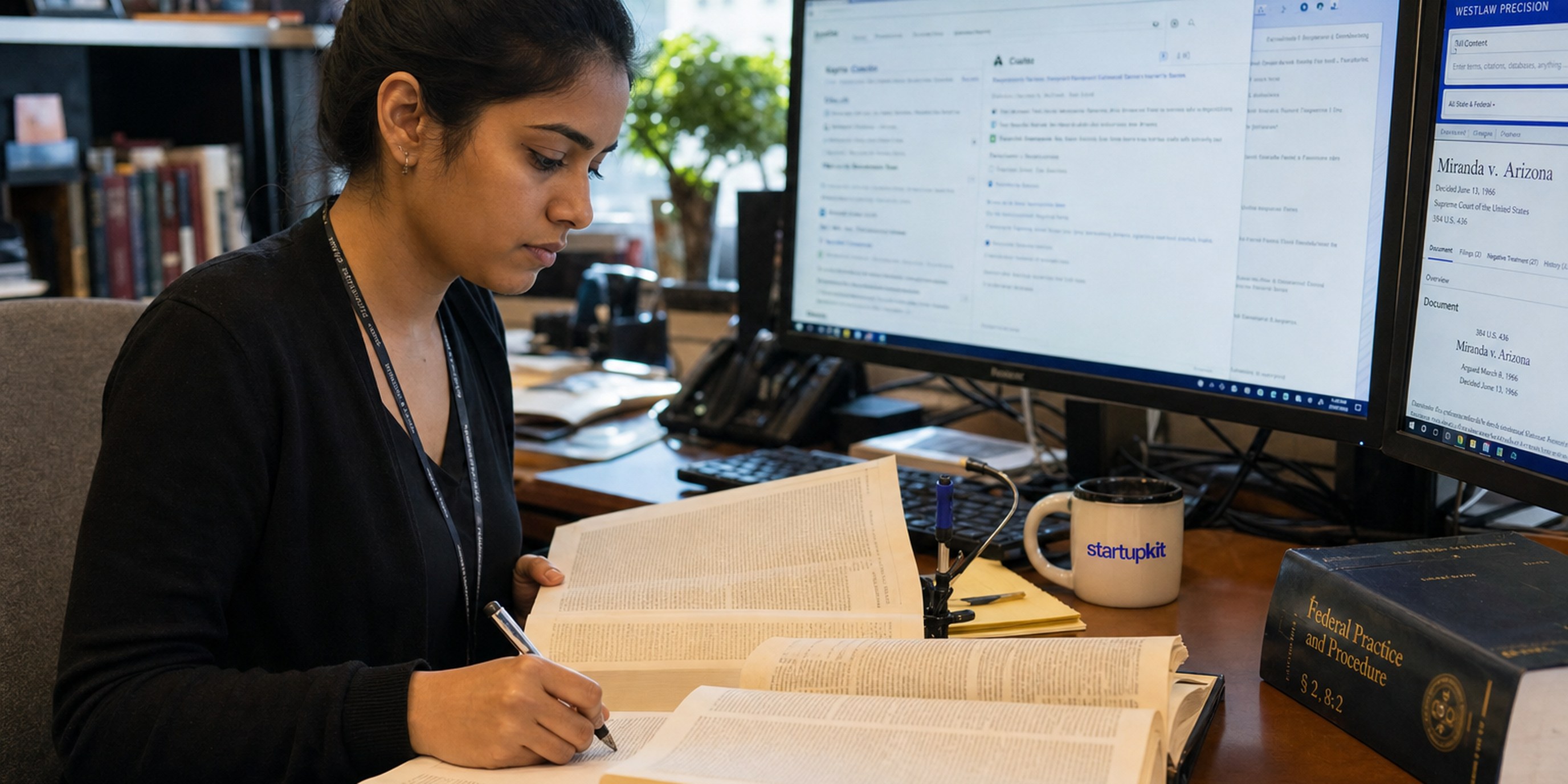
To hire a legal researcher in 2026, define the credential level you actually need (certified paralegal versus JD), write a job description that separates verification rigor from database name-dropping, source in remote-friendly markets plus the DC, NYC, and LA metros, and screen with a take-home research memo paired with an AI citation-verification round. The role has changed faster than most job descriptions: AI tools now produce research drafts in seconds, but they hallucinate cases often enough that your real hire is someone who catches the errors before they reach a filing.
That shift is the whole story. Legal Researcher ranked #23 on LinkedIn’s Jobs on the Rise 2026 list (US), among the 25 fastest-growing roles, based on member job starts analyzed from January 2023 through July 2025 (LinkedIn Economic Graph, 2026). Hiring well for it means understanding why demand is rising, what the job actually involves now, and how to test for the one skill that separates a good researcher from a liability.
What does a legal researcher do in 2026?
A legal researcher gathers and analyzes statutes, regulations, and case law to support litigation, policy, and advisory work for legal teams. LinkedIn defines the role precisely that way, and names Legal Writing, Litigation, and Corporate Law as its top three skills. The role is unusually remote-friendly for legal work: 42.1% of postings are remote and 17.1% hybrid, with a median of 2.8 years of prior experience and common feeder roles of law clerk, legal assistant, and teaching assistant (LinkedIn, 2026).
Three different buyers hire this role under three different titles, and knowing which one you are changes everything downstream.
- General counsel at a growth-stage company. You cannot justify a second attorney headcount, but you are drowning in research requests, regulatory tracking, and due-diligence work. You want a high-leverage researcher who frees up attorney time.
- Law firm hiring manager or practice-group lead. You need research-and-writing horsepower for litigation, briefs, and memos without paying associate rates.
- Legal-ops or knowledge-management lead. You are hiring a law-librarian-adjacent researcher to own legal knowledge infrastructure at a large org or law school.
The shared pain in 2026 is the same across all three: AI changed the job overnight. The research itself is faster, but the verification burden exploded. In a survey of legal leaders, 46% said they lack the right tools to succeed, with the gap most acute in legal research, information governance, and contract management (Peerpoint, 2026). You are no longer hiring someone to find cases. You are hiring someone fast enough to use AI and rigorous enough to catch what it fabricates.
Why is demand for legal researchers rising?
Demand is shifting, not simply swelling, and the distinction matters for how you sell the role. “Fastest-growing on LinkedIn” measures momentum in job starts, not total headcount. The closest official occupation, Paralegals and Legal Assistants (SOC 23-2011), is projected for little or no change from 2024 to 2034, roughly +600 jobs on a base of about 376,200, yet still generates around 39,300 openings per year from turnover and exits (BLS Occupational Outlook Handbook).
Read those two facts together and the picture sharpens. BLS attributes the flat aggregate growth directly to AI making these workers “more efficient at tasks such as conducting research and preparing documents.” Flat total headcount masks a real surge in demand for a specific profile: researchers who pair AI fluency with verification rigor. That is exactly the candidate LinkedIn’s ranking is picking up.
The market also favors candidates right now. The unemployment rate for paralegals and legal assistants was 3.6% in the first quarter of 2026, below the 4.3% national rate, and law firms posted 68,200 paralegal and legal-ops roles in 2025 (Robert Half, 2026). On the demand side, the legal field is leaning in: generative AI use among in-house legal teams jumped from 14% in 2024 to 26% in 2025, and 41 of the top 100 US firms by revenue have formally integrated generative AI (GC AI, 2026). More AI adoption means more drafts that need a human to verify them.
What should you look for in a legal researcher?
The single best predictor of a strong legal researcher in 2026 is research rigor under AI conditions: the ability to move fast with AI tools and still catch what they get wrong. Everything else supports that core. Here are the concrete signals to screen for, roughly in priority order.
- Primary-source verification habit. Does the candidate independently pull a cited case in an official reporter rather than trusting a summary? This is the most important behavior, full stop.
- Legal-writing clarity. Can they compress a complex issue into a clear, concise memo? LinkedIn names legal writing the #1 skill for the role.
- Database fluency. Westlaw, LexisNexis, and Bloomberg Law are table stakes, not differentiators.
- Citation accuracy and Bluebook command. Correct citation format is a reliable proxy for overall diligence.
- AI-tool literacy with healthy skepticism. They know the tools (CoCounsel, Lexis+ with Protégé, Westlaw Precision, Harvey) and, more importantly, their failure modes.
- Issue-spotting and resource prioritization. Given an ambiguous question, do they identify the controlling authority efficiently rather than boiling the ocean?
- Confidentiality and judgment. They handle privileged and sensitive material the way the job demands.
Which credentials and certifications actually matter?
Be precise here, because employers routinely overweight the wrong signals. No license is universally required. Unlike attorneys, legal researchers and paralegals are not licensed practitioners in most US contexts. Education typically means an associate’s degree or a paralegal certificate, though many employers prefer a bachelor’s, and a JD is sometimes required for court or federal research roles (Indeed).
Certification is voluntary and signals diligence, not legal standing. NALA’s Certified Paralegal (CP) and Advanced Certified Paralegal (ACP) are the common credentials. The trap to avoid: a certificate means completing a program, while certification means passing an independent exam (paralegal.edu). Employers conflate the two constantly. Decide which one you actually value, and write it correctly in the job description so candidates self-select accurately.
How much does a legal researcher cost in 2026?
Expect a national median around $61,010 for the most common mapping (paralegal/legal assistant), with wide variance by credential, industry, and metro. “Legal Researcher” is not a single BLS occupation; it spans three official buckets, and citing the wrong one is the fastest way to mis-benchmark an offer.
| Role mapping | SOC | 2024 median (national) | Range |
|---|---|---|---|
| Paralegal / Legal Assistant (most common) | 23-2011 | $61,010 | $39,710 (10th pct) to $98,990 (90th pct) |
| Law Librarian (KM / research-infrastructure) | 25-4022 | ~$64,320 (librarians) | law-librarian avg ~$69,128 |
| JD-credentialed research attorney | under 23-1011 | varies widely | senior major-market high end |
Sources: BLS, Paralegals, BLS, Librarians, PayScale, 2026.
Industry variance inside the paralegal bucket is large: finance and insurance paralegals earn a median of $76,960, versus $56,280 in state government (BLS). Robert Half’s 2026 paralegal range runs $55,000 (low), $68,250 (mid), and $87,250 (high) (Robert Half, 2026).
One number to handle with care: some aggregators list “Legal Researcher” around $139,000 average (ZipRecruiter). That figure conflates JD-credentialed and attorney-adjacent postings and is not consistent with the paralegal median. Treat the BLS $61,010 as your credible anchor, and reserve six-figure numbers for JD-level or senior research-attorney roles in high-cost markets. All three top hiring metros (DC, NYC, LA) sit at the high end of every range, so benchmark to your own location rather than a national average pulled upward by three expensive cities.
How should you write the job description?
A good legal researcher job description does one job well: it separates must-haves from nice-to-haves so the right candidates apply and the wrong ones screen themselves out. Vague requisitions are a measurable cost. Roles with unclear requirements take longer to fill and produce weaker shortlists, a pattern we covered in why vague requisitions stretch time-to-fill.
Be explicit about three things most postings leave fuzzy.
- Credential level. State whether you require a paralegal certificate, prefer CP/ACP certification, or genuinely need a JD. Do not write “JD preferred” if an experienced certified paralegal would do the work well, because you will price yourself out and slow the search.
- Database and citation expectations. Name the platforms (Westlaw, LexisNexis, Bloomberg Law) and the citation standard (Bluebook). This is how candidates gauge fit in five seconds.
- AI expectations. Say plainly that the role involves using AI research tools and verifying their output. This single line signals a modern, realistic process and attracts the rigor-first candidates you want.
Resist the urge to over-require a JD. For most in-house and firm research work, an experienced certified paralegal is a better and more affordable fit than a junior attorney who treats research as a stepping stone.
How should you structure the interview process?
The legal field already validated the work-sample model, so lean on it: hiring partners routinely request a writing sample because resumes do not predict research quality (Harvard Law OPIA). Your loop should center on a realistic research task, not on trivia.
Here is a tight, four-stage process adapted from proven structured-hiring practice.
- Screen (30 minutes). Role alignment, database experience, and communication clarity. Confirm the credential level matches.
- Take-home research memo (the core work sample). Give a realistic, self-contained legal question and 2 to 4 hours to produce a short memo with citations. It respects candidate time, runs asynchronously, and shows you exactly how they think and write.
- Citation-verification round. Hand the candidate an AI-generated research summary that contains planted errors: a hallucinated case, a mis-cited holding, and a sycophantic agreement with a wrong premise. Ask them to verify it. This directly tests the #1 skill for 2026 and almost no one does it, which makes it a powerful differentiator.
- Structured panel and scorecard. Score independently across research accuracy, writing clarity, and source judgment before discussing, so the loudest voice does not anchor the room.
That last point matters more than it sounds. Structured scorecards with independent ratings have meaningfully higher predictive validity than unstructured debriefs, which we unpack in how structured scorecards beat gut-feel interviews. Use a fixed rubric, and make citation accuracy its own line item.
A few interview questions that surface real signal:
- “Walk me through how you would find the controlling authority on this ambiguous issue.” (resource prioritization)
- “Tell me about a memo where your research changed the team’s strategy.” (impact)
- “How do you verify an AI research tool’s output before relying on it?” (the rigor signal)
- “Which databases do you reach for first, and why?” (fluency)
Why is AI verification the most important skill now?
Because even purpose-built legal AI hallucinates often enough to sink a filing, and verification is the only defense. The most rigorous evidence comes from a Stanford study, Magesh et al. (2025), “Hallucination-Free? Assessing the Reliability of Leading AI Legal Research Tools,” published in the Journal of Empirical Legal Studies. It found that roughly one in three Westlaw AI-Assisted Research answers and about one in six Lexis+ AI answers contained a hallucination, with general-purpose GPT-4 worse still (AI Law Librarians summary; JELS).
The study also named a specific failure mode: sycophancy, where the tool agrees with a wrong premise and fabricates support for it. That is precisely the trap a good researcher must catch, and precisely what your planted-error verification round tests.
The stakes are not hypothetical. In July 2025, a federal judge in the MyPillow case ordered two attorneys to pay $3,000 each for an AI-assisted filing that contained more than 20 fabricated or erroneous citations (Natural & Artificial Law). Hiring a researcher who trusts AI output blindly is no longer a quality issue. It is a liability. And with adoption climbing (35% of firms and corporations now use generative AI in routine legal work, a 72% year-over-year jump, while data security remains the top barrier for around 70% of firms per MyCase, 2025), the verification skill only grows in value.
What hiring mistakes should you avoid?
Most failed legal-researcher hires trace back to a short list of avoidable errors. Watch for these.
- Screening on database name-dropping. “Knows Westlaw” is table stakes. The real signal is whether they independently check a citation.
- Skipping the work sample. Credentials do not predict research and writing quality. Use the memo.
- Not testing AI verification. Almost no employer does, which makes it the easiest differentiator on this list and the one with the highest downside if you skip it.
- Confusing certificate with certification and over-weighting either. Both are voluntary, neither is a license.
- Mis-benchmarking pay off a single aggregator. Anchor to BLS plus your local market, not a $139,000 headline.
- Running a slow, ghosting-heavy process. In a 3.6%-unemployment market, top candidates accept other offers while you deliberate. Tighten your loop, as we argue in why too many rounds lose your best candidates.
- Over-requiring a JD when an experienced certified paralegal is the better, cheaper fit.
Frequently asked questions
Quick answers to the questions employers ask most when hiring a legal researcher.
Do you need a JD to be a legal researcher? No. Most legal researcher and paralegal roles are not licensed positions, and an associate’s degree or paralegal certificate is the common baseline. A JD is sometimes required only for court or federal research roles (Indeed). For most in-house and firm research work, an experienced certified paralegal is the better, more affordable fit.
How much does a legal researcher cost in 2026? Use the BLS paralegal/legal-assistant median of about $61,010 as your credible anchor, with a 10th-to-90th-percentile range of $39,710 to $98,990. Reserve six-figure numbers for JD-level or senior research-attorney roles in high-cost markets like DC, NYC, and LA.
What certifications matter for a legal researcher? Certification is voluntary and signals diligence, not legal standing. NALA’s Certified Paralegal (CP) and Advanced Certified Paralegal (ACP) are the common credentials. Distinguish a certificate (completing a program) from certification (passing an independent exam) and state which you value in the job description.
What is the best interview question for a legal researcher? “How do you verify an AI research tool’s output before relying on it?” It surfaces the single most important 2026 skill: catching hallucinated cases and mis-cited holdings before they reach a filing. Pair it with a take-home research memo and a planted-error citation-verification round.
How long does it take to hire a legal researcher? In a candidate-favorable market (3.6% paralegal unemployment in Q1 2026), a tight four-stage loop, screen, take-home memo, citation-verification round, and structured panel, moves faster than a slow multi-round process that loses top candidates to competing offers.
How does Kit help you hire a legal researcher?
Everything above points to the same operational need: run a fast, work-sample-centered process with a structured rubric and no candidate ghosting. That is what Kit is built for. Kit is an AI-native applicant tracking system for startups and lean teams, and its work-sample stage generalizes cleanly from engineering to legal research.
The same code-assignment stage that handles a GitHub take-home handles a legal research memo: the candidate submits asynchronously, and your team reviews against a shared rubric. Team review and voting give every reviewer an independent scorecard, so citation accuracy and writing clarity get scored on their own merits before anyone talks. Make the citation-verification round its own scorecard criterion and you have institutionalized the one test that catches AI hallucinations.
Kit’s role templates give you a pre-configured pipeline to adapt rather than build from scratch, and built-in interview scheduling plus email templates keep candidates moving in a market where a slow reply loses the hire. For teams running AI-assisted recruiting, Kit’s MCP integration lets an AI assistant manage the pipeline directly, advancing candidates and drafting outreach while your reviewers focus on judgment calls. The philosophy behind the work-sample stage is the same one we detail in how to structure assignments candidates don’t hate, translated to legal research: realistic, time-boxed, and scored on the work itself.
Hiring a legal researcher in 2026 comes down to one decision repeated at every stage: trust the work, not the resume. Define the credential level honestly, benchmark pay to the right occupation, and build a loop that tests verification rigor under real AI conditions. Do that, and you will hire the researcher who keeps fabricated citations out of your filings instead of the one who introduces them.
Ready to run that loop? Start a free trial and adapt a Kit pipeline to your first legal-researcher hire.
Related articles

Healthcare Bug Bounties Should Start Before a Breach
The Medyc incident shows why medical software vendors need a safe disclosure route and a funded bug bounty before someone exploits a reportable flaw.

How to Hire a Rails Engineer When AI Writes the Code
How to hire a Rails engineer for a startup: define the work, test a safe change in a real-looking app, and score judgment when AI can write the code.

AI Agent Security Incident Triage: Probe or Breach?
Use this AI agent security incident triage guide to preserve probe evidence, verify application access, contain exposure, and contact the right operator.
Human-Owned Recruiting Messages in an AI Hiring Workflow
Make recruiting messages clear and accountable when AI helps draft. Use this review guide for job ads, outreach, process updates, and rejection notes.

SSO Offboarding: A Vendor Checklist Beyond the Login
Use this SSO offboarding checklist to test existing sessions, API tokens, directory delays, and exceptions before accepting a SaaS vendor's access controls.

Leaked Credential Reports: A Practical Closure Checklist
Close a leaked credential report with evidence: remove exposure, invalidate the old secret, prevent recurrence, and document the limits of your impact review.
Try Kit for 30 days.
Hiring, security reports, and training in one account, for teams where none of it is a full-time job. Free for 30 days, card required. Cancel before it ends and you pay nothing.
Get started free